I can't remember not knowing El Salvador. I no longer have the images in my head of what it would be like before coming here. I know I wasn't scared or trepedatious, but while I am always curious about new places, I just hadn't been drawn to Central America previously. It was lumped into a box labeled hot and humid, bananas and sugarcane, troubled politics, and insecurity. Other than our Salvadoran housekeeper Jeanette who told me in the 1980s about crossing the border on foot while pregnant to escape the civil war, I didn't have other sources of information about the country to update these impressions.
It was sometime in 2018 when I ran into a friend in D.C. while eating lunch alone on a terrace at work one day. He had just arrived from overseas for a Washington assignment and over sack lunches we caught up on the intervening years since we'd last talked. He's someone whose kind and easygoing nature I've always appreciated, and as evidenced in his writing and photography, I felt we saw the details of life through a similar lens. Anyway, I mentioned I was bidding on my next assignment and was looking overseas, hopefully somewhere English or Spanish speaking.
What about San Salvador? He asked.
Hmmm, I hadn't really given it much thought, I replied, thinking about a friend who'd been in neighboring Honduras and told me she thought she needed therapy to recover from all the cockroaches she'd had to kill in her house.
I'm not so sure.
No really, it's great! You'd love it. Put it this way - for as much as I loved it there - my wife and four kids loved it even more. In fact, if the timing were better - I would consider going back.
Really? Hmmm...
That was the kind of endorsement I understood.
Clearly I did consider it, because now I can't even remember what it was like not to know this country: the faces, the landscape, the towns, the colors, the smells, the sounds, the weather, the birds, the history, the silliness, the work ethic, the local names, and overall - the warmth of the people. And now I can't imagine what it will be like to not live here anymore.
My husband and I dug into the country, observing daily life and talking to people in each of the 14 departamentos (states). While I have thousands of photographs of the country's gorgeous landscapes, these aren't its best assets. It's the people who make this country more beautiful than the sum of its beaches, waterfalls, volcanoes, mountains, and lakes. Therefore, it is their stories that should be told to bring to life to what happens alongside the lush scenery.
With acknowledged great generalization, I can lump El Salvador into three economic strata, each clearly divided from the next, and yet inseperably entwined, with the common thread among each being the tightly woven fabric of family.
 |
| The literal tightly woven fabric of family at a small San Sebastian family business. |
Let's start with the regular folks.
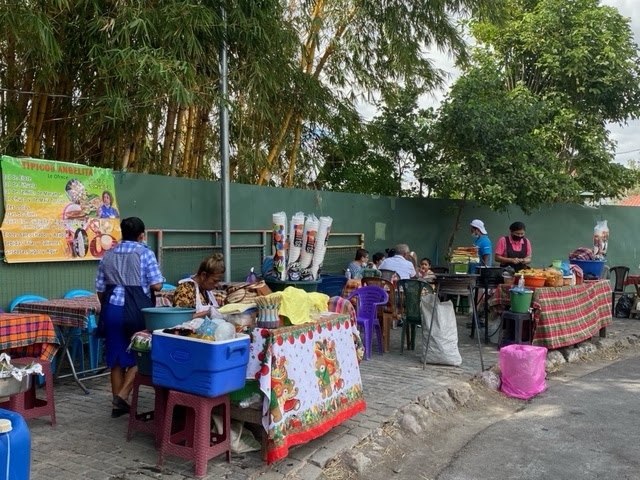
The other day my husband and I were driving home from the beach along the La Libertad highway. It's a four-lane highway connecting the capital San Salvador to the central coast beaches promoted collectively as "Surf City." We don't surf, but we do visit the beaches, so we were taking advantage of the well-paved road, complete with new bypass, to zip from shore to home in about 35 minutes. Here, as in other parts of the country, life is on display on the roadside. Given the steep topography of the country, with most places covered in dense or jungly vegetation, plus the fact that so many people don't own cars, walking along the road is often the only way to get anywhere. A good percentage of this country walk, wait for buses, sell things, cook food, sell food, eat food, hang their washing, dry their corn, or simply just visit with neighbors on the roadsides. All it takes is looking out the window to see what life for the majority of the population is like.
 |
| The most perfumy-delicious "panades" mangos: 3 for a buck |
As we headed home that day, I noticed three pre-teen girls walking in a tight cluster. Their heads turned in together, they were chatting and laughing about something. The three were thin and leggy as colts in their t-shirts and knee-length skirts, and each carried a sturdy plastic cántaro, a 3 gallon water jug. Each girl had a different colored cántaro: red, green, or blue. I saw they were empty as the girls carried them easily, tucked under an arm or swung by a few fingers in the handle. They were walking from their houses along the highway to the nearest water source, a walk they likely took a few times a day. Had I seen them on the reverse trip, they'd have balanced their cántaros on their heads, on top of a rodete (a circular fabric bun) to keep the 25+ pound jugs of sloshing water more stable. But in that moment, they were just young friends, laughing and going through their daily routines together. I smiled at seeing them, remembering my own early teen years walking languidly home with friends after school, taking our time to avoid the waiting house chores, homework, or general family oversight.
 |
| Carrying a tub of corn masa home, little brother "helping." |
A few minutes later we passed a family hurrying down the road. The father led the way about 20 feet ahead of his wife, a stern look on his face and his torso inclined forward in that gait that is still a walk but is about to be a jog. He looked very intent on getting somewhere and I wondered where that could be? His wife, rushing to keep up as best she could in flip-flops and a tight skirt, was carrying her toddler son draped across her body, supported into the crook of her right arm. With her left arm, she simultaneously held the boy's head to her left breast and also kept the left shoulder of her blouse from falling down as she nursed her son on the run. His legs and right arm swung limply with her quick steps, his dead-weight resting completely on his mother. My husband narrated the scene in the father's voice: "... and we're not stopping!"
Finally, another few minutes up the road we passed an elderly woman walking alone, carrying two full plastic bags. Her strides were short and labored, and her posture so stooped that her neck had to crane upwards to see where she was going, not unlike a turtle. I assumed she was on her way home after buying some food, but there were no markets nearby, so likely her bags were full of produce bought from neighbors. I hoped she didn't have far to go at that pace and also wondered if there would be anyone home to help her when she got there. But if there were, why did they let her make this trip herself?
.JPG) |
| An old man and some good friends in Juayua. |
In just 10 minutes, I saw the life span of a Salvadoran woman born into seriously low economics. I'm trying to avoid saying "poor" here, but there's no way around it. With the minimum wage somewhere around $300 per month, this majority of the population teeter on the economic brink. Barring extraordinary circumstances, the three girls will soon be the young mother breast feeding on the go, and eventually the stooped elderly woman, likely a widow, fending for herself. If they're lucky, enough family will have remained nearby to care for them or at least help out. The girls will probably stop school at 6th grade and thereafter go from caring for their parents and siblings to their own families. The cycle of life on display in one short car trip; it's no wonder Salvadorans consider making the trek north for what's generally considered "better opportunities."
Life in the Middle
Meanwhile, firmly in the middle class, we have three sets of Salvadoran friends currently considering leaving El Salvador to migrate to the United States. Not illegally, but because they are or soon will be beneficiaries of immigrant visas. While the country is the smallest in Central America at approximately the size of New Jersey, according to a recent study of the largest foreign-born populations in the United States, Salvadorans are fourth behind the population giants of Mexico, China, and India. With the Salvadoran diaspora in the United States at well over two million, and a total country population at just 6.3 million, there's an excellent chance that everybody has somebody in the United States. That means for many, legal migration through family is an ace held up the sleeve just in case.
 |
| Beach resort Mizata hosting international tourists and surfers who can afford it. |
Of our three friends, one family with two teen daughters has been excited about the prospect of moving to Georgia as the mother will soon be the recipient of a Special Immigrant Visa as reward for her years of service to the U.S. Embassy. While tempted by the possibility of expanding the educational and career opportunities for their girls, the parents are also concerned about starting afresh as mid-career professionals. They live comfortable, suburban lives now; they are not escaping poverty or insecurity. Instead, they are evealuating their current lives and concerns about the political and economic stability of their country against the reality of starting from scratch in a very expensive country without the family network that puts grandparents and cousins within easy reach. Plus, one family member is recovering from a serious illness that would be considered a pre-existing condition in future insurance coverage.
The next example is a dual-citizen friend, born in North Carolina to Salvadoran parents. He returned to live in El Salvador after college where he met his now wife. She just received her immigrant visa and they are poised to head north with their two very young children. But as he looks at the slim job prospects substantial enough to support a family of four and compares that to his current comfortable lifestyle - golfing on the weekend, friends with beach houses - they too question if it's worth it. Plus, the skyrocketing number of school shootings has them seriously concerned about brining up their children with that type of fear.
Finally, a third colleague will soon receive his immigrant visa and is tortured by the same "Is it really better there?" questions. His visa class requires him to be unmarried at the time of issuance, yet he's in a serious relationship. Should he immigrate, they would need to marry after he entered the United States and then be separated for a few years while she waited for him to petition for her own visa. They have a dog who is like their child, a home they're improving, and two solid jobs. While they speak perfect English, they also question job prospects, the cost of living, and starting afresh in a new culture and climate.
For the middle class where immigrating is not a decision based on necessity - it's questionable if the American Dream is the one for them (or if it even exists).
The Wealthy
To be more precise, the super wealthy, members of a small cadre of elite families engrained in the country for generations but not native to the land. Their last names are recognizable as being captains of industry, creators and concentrators of great wealth from coffee, construction, retail, banking, or real estate. Most seed money came from generations ago as the great-grandparents and great-great-grandparents moved to Central America from Europe or the Middle East and owned giant swaths of what is now El Salvador, making fortunes in coffee or indigo. Today the family names are replaced by the business conglomerates they operate.
 |
| With no claims that this little tyke is from a uber wealthy family, I'm still fairly confident she won't be carrying the family's water on her head. |
Although we live in a secure, middle to upper-middle class neighborhood with home prices similar to that of major U.S. cities, we don't rub shoulders with this level of wealth. But we have met a few, here and there, at the barn where I ride every week or through my husband's work in the Embassy's American Citizen Services section. There he took their passport renewal applications as many are dual citizens, and met their polite, perfectly mannered, bilingual children. After leaving his ACS job, my husband crossed paths with them again when looking to volunteer at foundations bearing their family names. In our limited experience, this upper crust has been very kind and welcoming and have not turned their noses up at us. We see their Ferraris on the streets and hear their helicopters overhead, rising above the din of the city's traffic. I've gone to the horse shows and seen the polo fields where they compete on beautiful, imported horses. Yet down at the stable where the two ends of the social strata form a circle, the grooms who care for these lovely horses do their best using makeshift or broken equipment to keep the horses healthy and the barns together.
"We improvise" was the response I got from the head groom when I asked about what tools they had to do their jobs. I think of the horse owners who can afford to helicopter from the barn to their beach house to avoid traffic and yet don't arrange appropriate machinery to clear tons of mud from the barnyard after a landslide, or to bury a horse who died of colic on the property overnight. It seems no backhoe was offered then to help the head groom dispose of the horse's body, so once again he improvised - with a machete and a shovel.
It is this disparity that bothers me the most about life here, but this a sensitive, complicated and therefore often untouched topic, so I'll leave it there.
Lasting Impressions
We've come to really love this country and the Salvadorans we've been fortunate to meet. It's a complex society - as most are - with each level depending on the other for its existence. While I've certainly experienced my share of frustrations and have shouted "If only they would...!" more than once, there are MANY aspects where El Salvador excels. First on that list are the tight-knit families who spend weekends together en masse, or the rural communities who raise their children collectively with large support structures. I compare that to the recognized rise in "more developed" countries of youth depression and suicide and question who's doing it better?
 |
| Spontaneous smiles for a stranger from a family. |
I regularly marvel at the Salvadoran ability not to take oneselves too seriously and let themselves have old fashioned FUN together. I relish their unequivical warmth towards visitors and immediate instinct to help someone out who needs it. Every goodbye is not an "Adios" but a "Que le vaya bien!" (take care!) delivered with a smile. Anyone with food near them will be wished "Buen provecho!" by another walking by. I see their back-breaking physical work to achieve what could be done so much easier with the right equipment - all without complaint. And among the majority, there is zero sense of entitlement, perhaps to a fault. What they receive is humbly accepted with thanks given.
Leaving here after four years, I know I will keep these people, their stories, their faces, their questions, their struggles, and their joys alive with me. I will leave you here with a snippet of a regular Sunday at the beach that to me exemplifies the spirit of El Salvador: a little dangerous, a bit chaotic, full of energy and love, and with the innate ability to let go and just enjoy.
These videos are best viewed full-screen to see the people's faces:
El Salvador - I leave you with a final "Quelevayabien!"




.JPG)


.JPG)
.JPG)
