Showing posts with label Cultural Differences. Show all posts

Sunday, June 29, 2025

Ponies, Boats, and Islands: Authentic Eastern Virginia

Nothing to me is more intriguing than exploring subcultures, the niche societies that actively maintain their history and traditional ways of life or livelihoods across generations, if not centuries. Those communities resisting the tidal surge of modern influence that drowns or dilutes to the brink of non-existence the original flavor and substance of culture. The more we homogenize our food, radio, media, music, and architecture, making each experience blandly predictable via franchises and "strip-mauled" towns, the more I find myself wanting to go back to the well spring, not the theme restaurant, but the authentic place.  

Perhaps this appreciation for the genuine comes from spending the majority of my life in movement, with shallow roots that have let me untether from terra firma and roll somewhere else, to be someone else, to experience something new. Fortunately, not everyone is so chameleon or we would have already lost the regional dialects, art, craft and music traditions, professions, trades, and food and cooking styles that give texture and interest to our collective "American" patchwork culture. Thankfully, there are folks who do stick around, continuing to grow where planted, maintaining their local food, traditions, and funny names for things. FranklyI want to experience them all. 

So motivated, my husband and I have been exploring close to our current Northern Virginia base and have found a lot of local flavor. Some of these spots are certainly not secrets, but are still worthy of highlighting for unique aspects of their environment, culture, or customs. I'd like to highlight two:

Chincoteague and Assateague Islands

Those who know me will only be surprised that it took me many decades to finally visit the feral ponies of Assateague Island, MD/VA and the island town of Chincoteague, VA. Assateague Island National Seashore is a long, narrow barrier island spanning two states, Maryland to the north and Virginia to the south. Composed primarily of marshes and long stretches of sandy beaches with just enough altitude and dirt to support forests, the island is home to the horses and ponies made famous in the classic children's book "Misty of Chincoteague" and the follow-on books "Stormy, Misty's Foal," "Sea Star: Orphan of Chincoteague," and "Misty's Twilight" which I savored one birthday gift at a time as a girl. While the feral ponies aren't indigenous to the island and their exact provenance is somewhat debated, history puts them in the area for 350 years, which in my book is long enough to be considered "local" - even by Virginia standards.  

We drove just over three hours from northern Virginia through DC, traversing Maryland and Delaware before popping back into Maryland and crossing the bridge onto the northern side of the national park. (Phew, that's a lot of state lines!) My husband proudly showed his lifetime senior national park pass at the entrance booth and under partly sunny but threatening skies, we headed down the paved road that is the northern spine on the Maryland side. Within minutes we came across a small band of ponies grazing on either side of the road. The horses have free range on the island reserve, so graphic caution signs abound, warning visitors to keep 40 feet away to avoid being charged, bitten, or kicked and that "a fed horse is a dead horse" - so no treats, no matter how amazing the photo could turn out. Keeping them feral (they're strictly speaking not "wild" or indigenous) is key to keeping them alive. We met this small band grazing on the marsh grasses as up-close-and-personal as my zoom lens would allow: 


Given our early pony spotting success, we naively assumed this would be our experience the next day as well. But evening was closing in and with plans to stay in Chincoteague that night, nearly an hour away, we crossed back to the mainland and drove south to our hotel. Chincoteague is also an island, sitting just off a long peninsula of eastern Virginia attached only to Maryland at the top. We crossed a long, low bridge over Chincoteague Bay to reach the island, a horizon of tourism infrastructure dotting the cliffs in the distance. The historic town makes no secret of its famous equine residents, nor its long stretches of beaches and nature watching accessible by (yet another) bridge over to Assateague. The town feels like it can't make up its mind between being a nature lover's paradise or a beach destination for folks who might really rather be a bit further north in Ocean City, MD having shots and going "Wooooo!" Beach themed and color-schemed condos and motels lined the two main streets alongside taco trucks, seafood restaurants, and artsy collectibles shops. We pulled into our motel and scrounged for an open restaurant on a shoulder-season Tuesday night. We found a little Italian place with a sassy waitress, then called it a night.

The next day we awoke to a drip, drip, drip from the ceiling onto the bed from the overnight rain penetrating the motel's log cabin construction. We moved the ice bucket into place and peeked through the curtains to find the town utterly socked in and a steady rain falling. With an entire day planned to visit this side of Assateague Island for pony and bird spotting, we were disappointed but undeterred by the wet. As the saying goes, "There is no such thing as bad weather, only inappropriate clothing." With raincoats and umbrellas, we headed for the park again. Besides the rain, we also faced a fierce headwind blowing unobstructed off the open Atlantic. The clever ponies had clearly taken refuge deep out of sight in the island forest and we were left with the visitor center, watching the seagulls navigate in the driving rain on the long spit of beach, and walking out to the red-and-white striped lighthouse in a break between the showers. All of which were amusing - but they weren't ponies. We resisted visiting the Museum of Chincoteague Island in town, mostly because I understood that both the original Misty and her foal Stormy had been preserved via taxidermy and were on display. I just... couldn't, and so didn't. Later when my husband took advantage of the wet weather for a nap, I found a very cozy library and spent a few hours skimming books I would neither be able to buy nor check out. 

I ducked into a colorful store featuring art, jewelry, home decor etc. from dozens of local artists. While exploring the collections, the chatty owner filled me in on local horse lore. Featured prominently in many photographs was a gorgeous liver chestnut stallion with Fabio-like long flaxen (blonde) mane, tail, and forelock hanging down over his eyes and his wide, white blaze. Looking like a central casting Hollywood hottie, I learned that "Surfer's Riptide" was the darling of Assateague and a direct descendent of the original Misty. So striking was Riptide's coloring and physique, that this year Breyer, the biggest name in model horses, created a model of the 17 year old stallion. His sire "Surfer Dude", perfectly named given his shaggy flaxen mane and forelock flirtatiously covering one blue eye, was an island legend that lived wild until his death at age 22. Coloring the story, the shopkeeper told me there was a nemesis stallion that picked fights with Riptide and had to be moved to a different herd on the Maryland side of the island (divided by a fence at the state line) to keep the two alpha males from injuring or killing each other. I can't verify this bit of gossip, but it makes for a great Sharks and Jets plotline.

This July, however, marks the 100th anniversary of the island's famous pony penning event, where designated mounted "saltwater cowboys" push the Virginia-side herd off Assateague to swim across the channel to Chincoteague and be herded through the streets to the town's auction grounds. The Virginia-side herd is managed very differently from the Maryland-side herd, and is under the care and control of the Chincoteague Volunteer Fire Company. The Maryland ponies, in contrast, are managed by the National Park Service and don't participate in the pony penning, swim, or auction event. The annual late-July auction acts to keep the herd at a manageable size for both the fire company's care and for the land resources the ponies occupy (with a herd maximum of 150 individuals). It is also a critical fund raiser for the volunteer fire company. The annual crop of foals, ready to be weaned at four to six months old, are identified for auction as either "buy-backs" or truly for sale to new ownership. The buy-backs, usually fewer than a dozen each year, are pure fund raisers with the high bidder getting naming rights and then re-donating the foal back to live on the Assateague reserve and perpetuate the herd. The pony swim event itself attracts tens of thousands of spectators from around the United States and internationally, lining the streets to watch the horses and foals swim from Assateague to Chincoteague and then work their way through the streets to the auction site at the town's carnival grounds. 

The rain finally stopped by late afternoon and just before dinner we scooted back across to Assateague Island with the hopes of one final pony spotting. And just as the forest opened to the broad, marshy horizon, we encountered a mixed band of about 20 mares, foals, and at least one stallion. The foals tucked their tiny tails to their rumps, chilly in their dripping coats, while grazing besides their dams. Visiting in rainy late May, while missing the excitement of the pony swim, we also avoided the throngs and enjoyed the ponies and birds in their serene surroundings instead.


Doing what horses do best: grazing, swishing flies, and hanging with the herd


In From the Rain - Chincoteague Island Library

Tangier Island - Into the Chesapeake!

The next morning, we drove just under an hour southwest across the far eastern spit of Virginia to the unfortunately-named, but lovely nonetheless, Chesapeake Bay town of Onancock.  Our sassy, potty-mouthed waitress from the Italian restaurant in Chincoteague seemed the right one to discretely ask, "Ummm, how do we pronounce this town?" She laughed and told us the correct pronunciation was O-NAN-cock, which we practiced saying so we would put the emphasis on the correct syllable. We wanted to get it right, as we'd be catching the Onancock-Tangier Island ferry at 10:00 the next morning and spending all day out in the middle of the Chesapeake Bay in what we'd understood was a VERY conservative, traditional community. We found the ferry, the Joyce Marie II with captain aboard, tied up at the small marina and paid him cash for two round-trip tickets back in time to his hometown, Tangier Island, VA.  

First, let me adjust the definition of the word "ferry" for you a bit. It's just a nice little fishing boat. And captain, he's just the guy who owns the boat. But he was as authentic as I'd imagined since first hearing about the island community, its disappearing "waterman" way of life, and their distinct dialect, preserved over hundreds of years by isolation and pride. The juxtaposition of such a well-preserved culture with the literal degradation of the island itself is cruelly ironic. Both are hanging on against rising water levels that sweep away chunks of the flat, marshy island each year, and the diminishing crab stocks that threaten the economic lifeblood of the residents. But binding the community is a rock-solid Methodist faith buoyed by a history of hundreds of years of surviving just barely above the water's edge, an hour's boat ride in either direction from more solid ground. The population continues to dwindle as young people move away from the waterman's crabbing/oystering life, many taking jobs on barges and tugboats in other states and leaving behind the elders to keep the community together.  

Onancock-Tangier Island Ferry, at your service. 

Tangier skyline a watery mirage

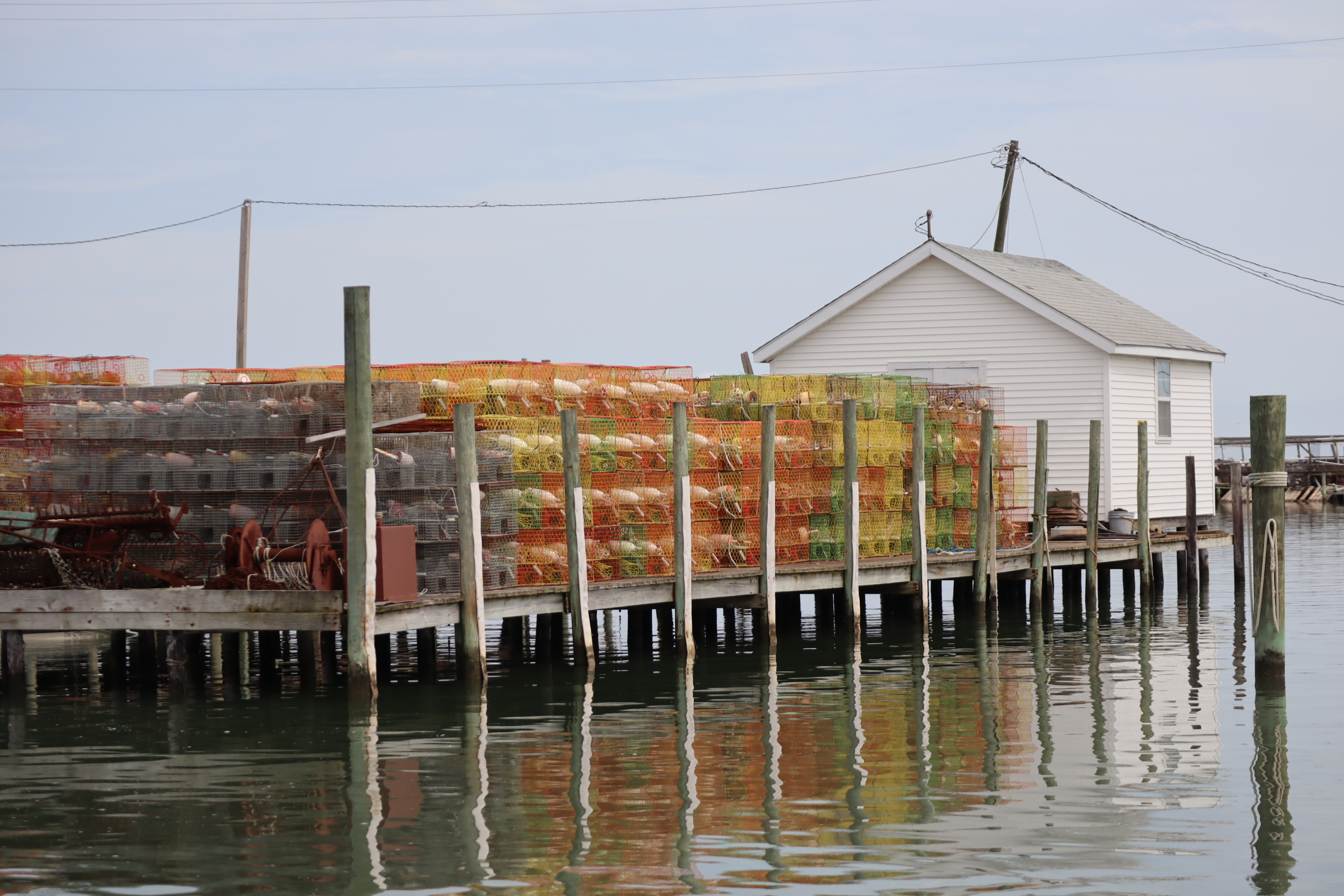
Watermen's crab shacks

Crab pots

After about 50 minutes of heading west to the middle of Chesapeake Bay, our captain pointed out what seemed like a watery mirage on the horizon; it was Tangier Island coming into view. Civilization where it seemed civilization had no business being. 

At the hour mark, we pulled into the marina lined on either side by long docks topped by crab shacks reaching into the Bay. Unlike arriving on other islands we've visited, whether volcanic, granite, or limestone, Tangier doesn't rise abruptly from deep water. Its ridges gently protrude up from the sandy Bay floor to just break the surface; the ferry's depth finder indicated only 10 feet of water beneath us. Our fellow passengers were two Verizon technicians making their weekly visit, a physical therapist doing the same, and an older woman returning home from visiting the mainland; we were the only tourists. We thanked the captain for a pleasant, smooth ride and agreed to see him at 3:30 for the return trip to Onancock. 

Immediately after stepping off the dock and onto the island, we were greeted by a young man in full Tangier accent touting tours of the island from his 6-seater golf cart. Just $7 a pop, and while we appreciated his offer, we preferred the independence to walk through the lanes at our own pace. Maybe later, we promised. 

The driest thing on the island seemed to be the alcohol sales prohibition, and after yesterday's heavy rain, the front yards of the houses lining the main street ranged from soggy to submerged. Cars were scarce, and those present were brought over years ago (the early 2000's Ford Ranger pickup a clear favorite for its rust-resistance, we were told) and sported Tangier Island resident stickers instead of state license plates. Like our would-be guide, everyone else zipped up and down the few roads in 4x4 buggies, golf carts, or bicycles. Many houses had raised wooden platforms with ramps to park their rides above the tideline, making me wonder how first floors of the houses fared.  

After getting our bearings, our first stop was the Tangier History Museum where a welcoming and knowledgeable woman greeted us from the counter in front of a small gift corner. All the crafts and treats were locally made, she proudly pointed out. Although tempted by one of the handmade lap blankets, I settled for a pot of blueberry-strawberry jam and some postcards. The museum was small, but well-organized and the space packed with exhibits. We spent just about an hour there, but easily could have spent more. Mostly a collection of local artifacts and clippings, the themed exhibits illustrated the island's history since about 1608: The waterman's livelihood whose crabbing and oystering has supported this insular community; their unique dialect; the evolving role of Tangier women over time; and how islanders have adapted time and again to losing land to storms, hurricanes, rising water levels, and soil erosion, among many other themes. The images of local photographer Cameron Evans were on display and chronicled island life and wildlife throughout the seasons. 


More than the words and phrases, it's also the accent that makes this dialect so unique. 

From the museum, we headed south down the main "ridge" of higher ground that supports a long, paved road lined on both sides by lovely houses. Some clearly Victorian era, others more modern, some abandoned, some for sale, others impeccably maintained, and others overgrown - all stages of life and death of a community were on display. And I mean "death" literally as small cemeteries, their burial plots above ground in cement vaults, dotted many front yards. Memorialized on the headstones were the islanders' names showing little variation; the most prominent among them Crockett, Dise, Thomas, Pruitt, Parks, Charnock, and Shores. Seeing these names repeated across all aspects of the island, I was reminded of the Assateague Island ponies, the lineage of each herd member carefully recorded. The records showed sire and dam names repeating throughout the pedigrees. I saw the parallel between the ponies and the Tangier Island families, each successfully adapting to their austere, non-native islands over hundreds of years; growing deep roots from sturdy root stock in both cases. 


The community was founded with a devout Methodist faith. 


With the school year just ending, signs decorating the main street congratulated in name and photo the single Tangier Combined School (grades K-12) high school graduate. The school has six teachers handling all grades and although small, according to local press, the students in grades 8-12 still celebrated the end of the school year with a prom. 

Island industry, historically reliant on crabbing and oystering, has diversified to support tourism, too. Many of the well-maintained Victorian homes are now inns and a quick AirBnB search showed no fewer than eight properties offering lodging and promoting a quiet stay of enjoying fresh crab, kayaking through marshes, birdwatching, or just sipping lemonade on porch swings at sunset.
 
Turning west off Main Ridge Rd, the primary commercial road with the marina, gift shops, museum, church, school, and restaurants, we crossed a small bridge over the marsh and creek that divided the island lengthwise and found the aptly-named West Ridge Road. We followed signs along a sandy track towards the public beach, a narrow stretch of soft sand and dune grasses. We sat a while and recognized just how small we were on this precarious slip of land in the middle of the Bay. We could have continued along the shoreline to the east on a long sandbar that ends in a hook like a miniature Cape Cod. Here is where the island gradually blends, like a watercolor, into Chesapeake Bay, finally disappearing under the water's surface.

Creek and marshes that perforate the island between its ridges of firmer land.

The public beach on what feels like an ocean shore.


Hungry by mid-day, we turned back to the main road and found Lorraine's Seafood Restaurant, recommended to us by both our ferry captain and the woman in the museum. She insisted we couldn't visit Tangier without eating something crabby for lunch, and Lorraine's would be the place to find it. Although we'd been the only tourists on the once-daily Onancock ferry run, we found the restaurant hopping busy at lunch, every table full and the restaurant staff running. Observing the other patrons, I didn't get the impression they were all locals and wondered where these folks had come from. We learned about a larger ferry making (seasonal) daily runs from Crisfield, MD and an even larger day-cruise boat from Reedville, VA. The day trippers would keep the restaurants, golf cart tours, and gift shops busy with a smaller percentage of tourists staying overnight. As we'd promised, my husband ordered their popular softshell crab sandwich and I tried the crabcake sandwich. I grabbed the hot sauce from another table to kick up the flavor a bit, but everyone else seemed to be raving about the local specialties.  

By 3:15 we headed back to the dock to meet our return ferry. Onboard again were the Verizon technicians, the physical therapist, plus three women returning home to Richmond. They'd stayed a few nights at the Bella Vista Cottage and were delivered in a golf cart to the ferry dock by their host, hugging the women goodbye as if they were old friends. Their first trip to the island too, the three recounted exploring all the town offered by day and savoring quiet sunsets on the large rear porch of the cottage, overlooking the Chesapeake Bay by evening. We pulled away from the dock and motored east towards Onancock, watching the island fade against the horizon. 

That day on Tangier Island, we entered an Americana time capsule built on a bedrock of Methodist faith, determination, and hard work. Drying laundry flapped in breezy backyards, cats lazed in sunny spots, coexisting with hens and chicks pecking in the grass of front yards, and American flags waved from porches. From this angle, it was all too easy to deny the ubiquitous modern world noise that assaults our senses and to retreat to a place and time that emphasizes a quiet, simple life. But running undeniably in the background is the existential threat facing the island. Residents are desperate for federal funding and Army Corps of Engineers efforts to construct living barriers and seawalls to protect it from further degradation; however, estimates put the projects into the $250-350 million range. Conservative to its core, I wondered about the future of the community where conservative values don't currently align with environmental preservation.  

The "politically incorrect" credo proudly on display.


Perhaps they are relying on a higher power for final salvation.


Saturday, August 19, 2023

Uprooted: Culture Shock in One's Own Country

 It didn't take much time working in our garden for me to declare that no seed falls on infertile soil in El Salvador. New sprouts popped through the dirt before I'd even hung up the rake, potting soil came with stowaways confidently sprouting by the time I cut open the bag, and a thin layer of dust on the patio was encouragement enough for something to take root and unfurl a few leaves before we unceremoniously plucked it out. 

This shouldn't have been a surprise; it's a tropical, agreeable climate with an ample supply of both water and sunshine. Seeing a sapling pushing undeterred through a crack in the pavement or a retaining wall never ceased to make me smile. Beyond the environmental factors, however, Salvadorans themselves are naturally open and welcoming, their easy smiles and relaxed manners inviting you to not hurry on, but sit and enjoy a moment. The warmth of the climate and people simply encourages everything to grow roots, to persevere despite difficulty, to live and to thrive. So we did. We let our own roots grow, establishing a home, friendships, favorite places, and learning not just the roads, but also the way. 

Therefore it felt all the more brusque when our tour ended and it was our turn to be yanked from the soil. This was our ninth move in 12 years, yet it was by far the most difficult. It seems we'd become rootbound.

Initially, I was really looking forward to returning to the United States. I longed for the comfort of the familiar, for cultural fluency, familial proximity, for not being the foreigner, for being able to express myself with clarity, nuance, even humor, instead of blunt basics. Plus, we'd have changing seasons, plants we'd know the names of, and driving habits that wouldn't make us shout. But with just two weeks back on U.S. soil, I'm finding the transition to be less of an easy slide into comfortable slippers and more like I got off at the wrong bus stop and am standing on the corner wondering where in the hell am I?

While in the past four years we had a few family visits and a one-month home leave to the U.S., in retrospect I see that was enough to merely notice the cultural shifts without having to adapt to them. The pandemic exponentially accelerated what might have been normal, evolutionary changes, leaving me and my husband running to catch up. Whereas the pandemic's lasting effects on El Salvador seemed only to be that restaurants plastic-wrapped meals before carrying them from the kitchen to the table, it feels like American culture is still bent on reducing human interaction and keeping people in the "comfort of their own home." What were initially pandemic-era necessities have stuck around as the new normal way of life. Businesses tout being contact-less, door-to-door delivery, no-cash, easy peasey. Malls and office buildings are nearly empty as everyone shops online; grocery stores are mostly self-checkout; and medical appointments are increasingly virtual. All this requires more technology and less humanity. "There's an app for that" does not warm our hearts but instead makes us grind our teeth as we create yet another account, user name and password, only to be rewarded with promises that all the data sharing will make our lives so much easier. 

The other night we were having Vietnamese Pho for dinner at a nearby restaurant and because I simply can't resist, I started a conversation with the Vietnamese waitress. The place wasn't too busy and she was quite chatty, and so within about 10 minutes we'd learned quite a lot about her and her immigration journey, which was really interesting. While she was recounting her story, I saw a handful of individual customers come into the restaurant, pick up their to-go orders, pay the cashier, and leave without so much as a glance around the restaurant.

Convenient? I suppose, but is that the only value we have these days? By staying isolated in self-controlled environments we are missing out on the happenstance interactions with people, animals, and even the weather that give our daily lives color, interest, depth, and a better understanding of the other beings around us. Is this really the most fertile environment for life

Waiting for the bus the other day, no doubt grousing about this unfamiliar world we'd found ourselves in, my husband wisely concluded, "We just have to consider this a transition to a new culture, as we've done before. We have to figure out from scratch how to adapt." He's right, because so far it feels like an inhospitable climate that doesn't want us to grow roots, but instead just wants to extract our resources and leave us wilted and yellow. 


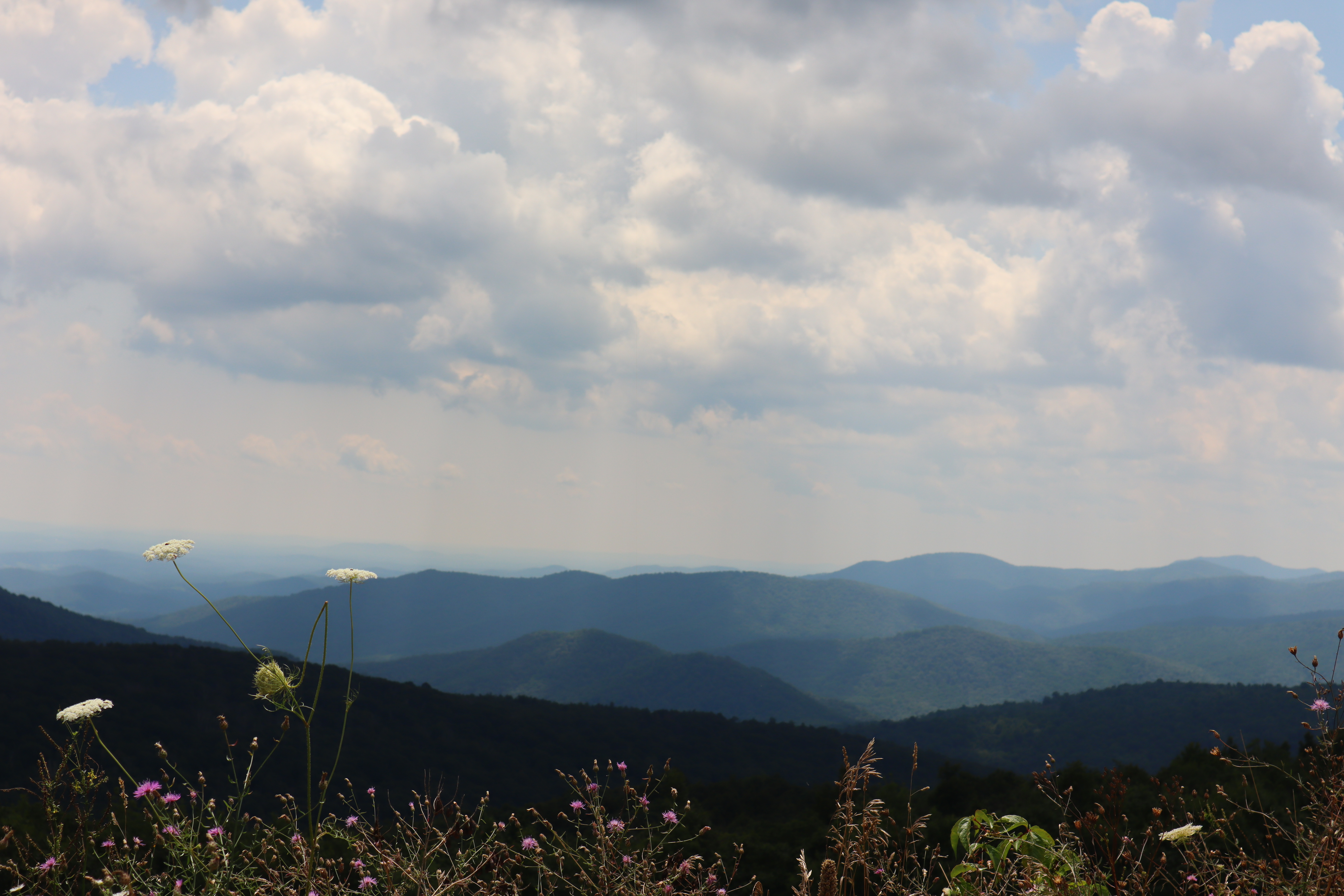
To weather these changes, I need to soak up the parts of this American life that still fuel me, to fertilize my own roots, if you will. I can do this by having analog interactions with others to remind me of their humanity and not just their other-ness. I can do this by getting away from the sterile, paved-over environment and into the trees, along the water's edge, and out to broad horizons. There is nothing more soul-affirming than sitting on a precipice overlooking a valley and being face-to-face with what is tangible, grand, and inspiring. Something that has - and will - outlast the things of man.


Now that's the type of soil I can grow in.

Sunday, June 25, 2023

El Salvador - Que Le Vaya Bien

 I can't remember not knowing El Salvador. I no longer have the images in my head of what it would be like before coming here. I know I wasn't scared or trepedatious, but while I am always curious about new places, I just hadn't been drawn to Central America previously. It was lumped into a box labeled hot and humid, bananas and sugarcane, troubled politics, and insecurity. Other than our Salvadoran housekeeper Jeanette who told me in the 1980s about crossing the border on foot while pregnant to escape the civil war, I didn't have other sources of information about the country to update these impressions. 

It was sometime in 2018 when I ran into a friend in D.C. while eating lunch alone on a terrace at work one day. He had just arrived from overseas for a Washington assignment and over sack lunches we caught up on the intervening years since we'd last talked. He's someone whose kind and easygoing nature I've always appreciated, and as evidenced in his writing and photography, I felt we saw the details of life through a similar lens. Anyway, I mentioned I was bidding on my next assignment and was looking overseas, hopefully somewhere English or Spanish speaking.  

What about San Salvador? He asked.

Hmmm, I hadn't really given it much thought, I replied, thinking about a friend who'd been in neighboring Honduras and told me she thought she needed therapy to recover from all the cockroaches she'd had to kill in her house.  

I'm not so sure. 

No really, it's great! You'd love it. Put it this way - for as much as I loved it there - my wife and four kids loved it even more.  In fact, if the timing were better - I would consider going back.  

Really? Hmmm...

That was the kind of endorsement I understood. 

Clearly I did consider it, because now I can't even remember what it was like not to know this country: the faces, the landscape, the towns, the colors, the smells, the sounds, the weather, the birds, the history, the silliness, the work ethic, the local names, and overall - the warmth of the people.  And now I can't imagine what it will be like to not live here anymore.  

My husband and I dug into the country, observing daily life and talking to people in each of the 14 departamentos (states). While I have thousands of photographs of the country's gorgeous landscapes, these aren't its best assets. It's the people who make this country more beautiful than the sum of its beaches, waterfalls, volcanoes, mountains, and lakes. Therefore, it is their stories that should be told to bring to life to what happens alongside the lush scenery. 

With acknowledged great generalization, I can lump El Salvador into three economic strata, each clearly divided from the next, and yet inseperably entwined, with the common thread among each being the tightly woven fabric of family

The literal tightly woven fabric of family at a small San Sebastian family business.

Let's start with the regular folks.

The other day my husband and I were driving home from the beach along the La Libertad highway. It's a four-lane highway connecting the capital San Salvador to the central coast beaches promoted collectively as "Surf City." We don't surf, but we do visit the beaches, so we were taking advantage of the well-paved road, complete with new bypass, to zip from shore to home in about 35 minutes. Here, as in other parts of the country, life is on display on the roadside. Given the steep topography of the country, with most places covered in dense or jungly vegetation, plus the fact that so many people don't own cars, walking along the road is often the only way to get anywhere. A good percentage of this country walk, wait for buses, sell things, cook food, sell food, eat food, hang their washing, dry their corn, or simply just visit with neighbors on the roadsides. All it takes is looking out the window to see what life for the majority of the population is like.


The most perfumy-delicious "panades" mangos: 3 for a buck

As we headed home that day, I noticed three pre-teen girls walking in a tight cluster. Their heads turned in together, they were chatting and laughing about something. The three were thin and leggy as colts in their t-shirts and knee-length skirts, and each carried a sturdy plastic cántaro, a 3 gallon water jug. Each girl had a different colored cántaro: red, green, or blue. I saw they were empty as the girls carried them easily, tucked under an arm or swung by a few fingers in the handle. They were walking from their houses along the highway to the nearest water source, a walk they likely took a few times a day. Had I seen them on the reverse trip, they'd have balanced their cántaros on their heads, on top of a rodete (a circular fabric bun) to keep the 25+ pound jugs of sloshing water more stable. But in that moment, they were just young friends, laughing and going through their daily routines together. I smiled at seeing them, remembering my own early teen years walking languidly home with friends after school, taking our time to avoid the waiting house chores, homework, or general family oversight.  

Carrying a tub of corn masa home, little brother "helping."

A few minutes later we passed a family hurrying down the road. The father led the way about 20 feet ahead of his wife, a stern look on his face and his torso inclined forward in that gait that is still a walk but is about to be a jog. He looked very intent on getting somewhere and I wondered where that could be? His wife, rushing to keep up as best she could in flip-flops and a tight skirt, was carrying her toddler son draped across her body, supported into the crook of her right arm. With her left arm, she simultaneously held the boy's head to her left breast and also kept the left shoulder of her blouse from falling down as she nursed her son on the run. His legs and right arm swung limply with her quick steps, his dead-weight resting completely on his mother. My husband narrated the scene in the father's voice: "... and we're not stopping!" 

Finally, another few minutes up the road we passed an elderly woman walking alone, carrying two full plastic bags. Her strides were short and labored, and her posture so stooped that her neck had to crane upwards to see where she was going, not unlike a turtle. I assumed she was on her way home after buying some food, but there were no markets nearby, so likely her bags were full of produce bought from neighbors. I hoped she didn't have far to go at that pace and also wondered if there would be anyone home to help her when she got there. But if there were, why did they let her make this trip herself? 


An old man and some good friends in Juayua.

In just 10 minutes, I saw the life span of a Salvadoran woman born into seriously low economics. I'm trying to avoid saying "poor" here, but there's no way around it. With the minimum wage somewhere around $300 per month, this majority of the population teeter on the economic brink. Barring extraordinary circumstances, the three girls will soon be the young mother breast feeding on the go, and eventually the stooped elderly woman, likely a widow, fending for herself. If they're lucky, enough family will have remained nearby to care for them or at least help out. The girls will probably stop school at 6th grade and thereafter go from caring for their parents and siblings to their own families. The cycle of life on display in one short car trip; it's no wonder Salvadorans consider making the trek north for what's generally considered "better opportunities." 

Life in the Middle

Meanwhile, firmly in the middle class, we have three sets of Salvadoran friends currently considering leaving El Salvador to migrate to the United States. Not illegally, but because they are or soon will be beneficiaries of immigrant visas. While the country is the smallest in Central America at approximately the size of New Jersey, according to a recent study of the largest foreign-born populations in the United States, Salvadorans are fourth behind the population giants of Mexico, China, and India. With the Salvadoran diaspora in the United States at well over two million, and a total country population at just 6.3 million, there's an excellent chance that everybody has somebody in the United States. That means for many, legal migration through family is an ace held up the sleeve just in case. 

Beach resort Mizata hosting international tourists and surfers who can afford it.  

Of our three friends, one family with two teen daughters has been excited about the prospect of moving to Georgia as the mother will soon be the recipient of a Special Immigrant Visa as reward for her years of service to the U.S. Embassy. While tempted by the possibility of expanding the educational and career opportunities for their girls, the parents are also concerned about starting afresh as mid-career professionals. They live comfortable, suburban lives now; they are not escaping poverty or insecurity. Instead, they are evealuating their current lives and concerns about the political and economic stability of their country against the reality of starting from scratch in a very expensive country without the family network that puts grandparents and cousins within easy reach. Plus, one family member is recovering from a serious illness that would be considered a pre-existing condition in future insurance coverage. 

The next example is a dual-citizen friend, born in North Carolina to Salvadoran parents. He returned to live in El Salvador after college where he met his now wife. She just received her immigrant visa and they are poised to head north with their two very young children. But as he looks at the slim job prospects substantial enough to support a family of four and compares that to his current comfortable lifestyle - golfing on the weekend, friends with beach houses - they too question if it's worth it. Plus, the skyrocketing number of school shootings has them seriously concerned about brining up their children with that type of fear. 

Finally, a third colleague will soon receive his immigrant visa and is tortured by the same "Is it really better there?" questions. His visa class requires him to be unmarried at the time of issuance, yet he's in a serious relationship. Should he immigrate, they would need to marry after he entered the United States and then be separated for a few years while she waited for him to petition for her own visa. They have a dog who is like their child, a home they're improving, and two solid jobs. While they speak perfect English, they also question job prospects, the cost of living, and starting afresh in a new culture and climate. 

For the middle class where immigrating is not a decision based on necessity - it's questionable if the American Dream is the one for them (or if it even exists).  

The Wealthy

To be more precise, the super wealthy, members of a small cadre of elite families engrained in the country for generations but not native to the land. Their last names are recognizable as being captains of industry, creators and concentrators of great wealth from coffee, construction, retail, banking, or real estate. Most seed money came from generations ago as the great-grandparents and great-great-grandparents moved to Central America from Europe or the Middle East and owned giant swaths of what is now El Salvador, making fortunes in coffee or indigo. Today the family names are replaced by the business conglomerates they operate.

With no claims that this little tyke is from a uber wealthy family, I'm still fairly confident she won't be carrying the family's water on her head.

Although we live in a secure, middle to upper-middle class neighborhood with home prices similar to that of major U.S. cities, we don't rub shoulders with this level of wealth. But we have met a few, here and there, at the barn where I ride every week or through my husband's work in the Embassy's American Citizen Services section. There he took their passport renewal applications as many are dual citizens, and met their polite, perfectly mannered, bilingual children. After leaving his ACS job, my husband crossed paths with them again when looking to volunteer at foundations bearing their family names. In our limited experience, this upper crust has been very kind and welcoming and have not turned their noses up at us. We see their Ferraris on the streets and hear their helicopters overhead, rising above the din of the city's traffic. I've gone to the horse shows and seen the polo fields where they compete on beautiful, imported horses. Yet down at the stable where the two ends of the social strata form a circle, the grooms who care for these lovely horses do their best using makeshift or broken equipment to keep the horses healthy and the barns together. 

"We improvise" was the response I got from the head groom when I asked about what tools they had to do their jobs. I think of the horse owners who can afford to helicopter from the barn to their beach house to avoid traffic and yet don't arrange appropriate machinery to clear tons of mud from the barnyard after a landslide, or to bury a horse who died of colic on the property overnight. It seems no backhoe was offered then to help the head groom dispose of the horse's body, so once again he improvised - with a machete and a shovel.

It is this disparity that bothers me the most about life here, but this a sensitive, complicated and therefore often untouched topic, so I'll leave it there. 

Lasting Impressions

We've come to really love this country and the Salvadorans we've been fortunate to meet. It's a complex society - as most are - with each level depending on the other for its existence. While I've certainly experienced my share of frustrations and have shouted "If only they would...!" more than once, there are MANY aspects where El Salvador excels. First on that list are the tight-knit families who spend weekends together en masse, or the rural communities who raise their children collectively with large support structures. I compare that to the recognized rise in "more developed" countries of youth depression and suicide and question who's doing it better? 

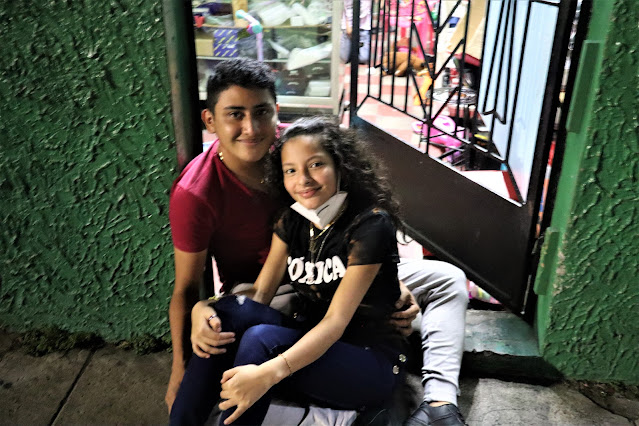
Spontaneous smiles for a stranger from a family.

I regularly marvel at the Salvadoran ability not to take oneselves too seriously and let themselves have old fashioned FUN together. I relish their unequivical warmth towards visitors and immediate instinct to help someone out who needs it. Every goodbye is not an "Adios" but a "Que le vaya bien!" (take care!) delivered with a smile. Anyone with food near them will be wished "Buen provecho!" by another walking by. I see their back-breaking physical work to achieve what could be done so much easier with the right equipment - all without complaint. And among the majority, there is zero sense of entitlement, perhaps to a fault. What they receive is humbly accepted with thanks given. 

Leaving here after four years, I know I will keep these people, their stories, their faces, their questions, their struggles, and their joys alive with me. I will leave you here with a snippet of a regular Sunday at the beach that to me exemplifies the spirit of El Salvador: a little dangerous, a bit chaotic, full of energy and love, and with the innate ability to let go and just enjoy. 

These videos are best viewed full-screen to see the people's faces:


El Salvador - I leave you with a final "Quelevayabien!" 

Sunday, February 06, 2022

Road Bingo: El Salvador Edition

 Every country, just like every person, has its quirks and certain ways of doing things which upon first observation, elicit responses in me that range from amazement, to being instantly charmed, to somewhat annoyed, to aghast. This collection of novelties, as it were, like the language, food and climate of a place combine to create the flavor of the country that differentiate it from its neighbors and let us know in no uncertain terms that we're somewhere else. Adaptation, either to stay alive or just to navigate daily life, activates the senses in figuring out how to appropriately react and act in any new situation. No doubt many of these idiosyncracies are not exclusive to one place, but appear in other countries as well with their own indigenous twists. As you get to know a place, recognizing the local oddities requires attention to detail and a sense of humor to ensure your experience moves from exasperating to successful and maybe even fun. Example: "Oh, here they exit the roundabouts from the INSIDE lane?"

After living in El Salvador for 2.5 years, I've collected fifteen localisms that I can count on experiencing in a given day. I don't mean a work day when I'm stuck inside, but a day when we're out and about on the road. I'll tempt fate by saying I can guarantee you'll witness half of these in just a 15 minute drive, but really - you will.  Go for two hours on a weekend and the chance of seeing the entire list rises to about 80 percent.  You'll see these have nothing to do with language or food, instead they're all observable from the road.  Which is why I'm calling this Salvadoran Road Bingo.   

I'll give the list with descriptions, in no particular order, and then present a body of evidence for you to have your own little windshield tour of the country.  The quality of these photographs is often poor as capturing them involves me grabbing and trying to focus my camera quickly from the moving car, because after all, that's the whole point.  Here we go:

1. At least three still-running, mid-1980s Toyota Tercels. 
In particular, the 1985. How am I able to be so specific? I'm not a car nut, but this was the first car I ever bought and I still recognize its boxy self. And recognize it I do -  EVERYWHERE.  America, let me tell you, you just didn't squeeze enough juice out of this car before thoughtlessly sending it out of the country where it has enjoyed an extremely fruitful second life on the streets and highways of Central America. Mexico may be mad for the VW Beetle, but El Sal loves the Tercel. Hatch-back, SR5 wagon, two or four door - they're all here and going strong. 

2. Someone peeing alongside the road.
Certainly not endemic to only El Salvador, but this classic is such a reliable sight that it had to make the list.  And the fact that public urination is a punishable offense in many countries gives its inclusion on this list of quirks credence.  Notice I didn't say a MAN peeing alongside the road.  This was not an oversight. 

3. Someone driving 15-40 mph under the speed limit.
Certainly this habit has to do with people driving 37-year-old underpowered cars, but not always.  In fact, it seems to be drivers in later model cars that are the more often guilty of driving 16 mph on well-paved roads under good conditions, for no apparent reason.  My hunch is that it's simply a lack of confidence in driving abilities, because it seems to be neither gender nor age-specific.  I just wish they'd use the right lane when they do it. 

4.  A wandering minstrel.
Exactly as it sounds.  A guy with a guitar, and sometimes the whole band, either on foot or on a bicycle - heading off to warm the hearts of a couple on their first date at some restaurant.  Do I even need to mention the hat requirement?

5. An astounding tree.
I mean the kind of tree that makes you stop and take pictures.  Either because of it's impressive height, girth, or the color of its blossoms. But what gets me is the reach and tangle of branches, stretching across the road to touch the opposite edge and providing rain and sun shelter for the inevitable gathering of life beneath. 

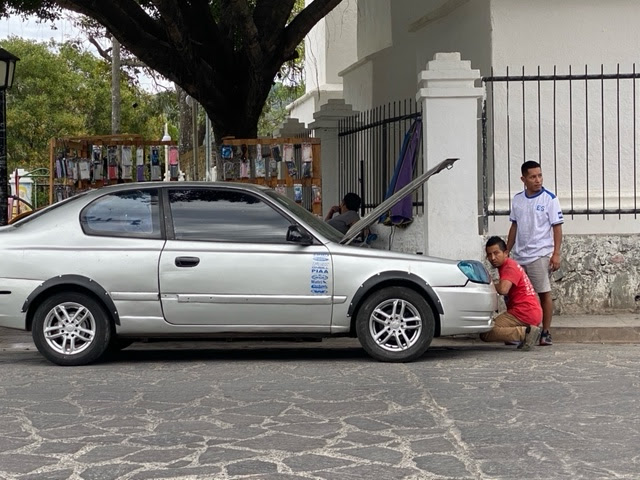
6. Someone helping a buddy with a breakdown.
See again the first and third entries above for background. When you drive cars that rolled off the assembly line before there were assembly lines - the chance of a roadside breakdown is pretty high.  But where this becomes a localism, and an illustratation of the closeness of Salvadoran family and friendships, is that everyone seems to know a guy who can come help. Available at the drop of a hat, they'll slide under the disabled car, legs protruding into the road, or crawl up under the hood with a pen flashlight in their teeth to see what's up.  And just like driving too slowly, this is not relegated only to old cars, but to any model, any year, which I fear says more about lack of understanding of basic car maintenance or tire selection than economics.

7. Something that makes you smile.
The first of our open-to-interpretation items on the Bingo board. No matter my mood, there will always be something that makes me smile.  Usually it's another person smiling at me, or at someone else, that is sweetly contagious.  Salvadorans are very affectionate, open and kind people by nature which places this habit in juxtaposition with many other places where a frown is the default setting.

8. Taking a siesta ANYWHERE.
I thought it was only soldiers who learned how to sleep flat on their faces in the dirt. I was wrong; Salvadorans can catch a few winks in any setting, on any surface - moving or stable. Please don't take this as a veiled attempt at labeling them lazy, because it is not. Quite the opposite, they are exceedingly hard-working folks, which is why just after lunch - there's a need for a cat nap.  And if that happens to be in a wheelbarrow - so be it. 

9. A man with a machete.
Don't be afraid, but a lot of men carry machetes a lot of places. Okay, there are certain times and places when you should be very afraid of seeing a guy with a machete, but in broad daylight, walking down the road is not one of them. This is a tropical country where no seed falls on infertile soil.  This means that frequently nature has to be whacked into submission so that we still have passable roads and paths, and gardens and crops not strangled by weeds.  Hence, the machete. Usually it's slung over a shoulder in a fringed leather sheath with EL SALVADOR carved along the length. 

10. Something incredibly beautiful. 
Another in the eye-of-the-beholder category.  Whether it's coming around the corner and being surprised by the view over a craggy cliff to the crashing waves, a volcano filling the horizon, or simply a brightly colored mural lining the main street of a dusty town. Something will brighten your view for just a moment and give you reason to be amazed. 

11. Someone selling something unrecognizeable.
This could be a crop of something in season, some type of fruit or vegetable stacked on crates, something hanging to dry that later will be stewed or ground-up or... I don't know, something floating in a small plastic bag and waved at your car window, and something unnaturally colored to catch your attention.  I'd tell you what all these things are, but I still haven't figured them out. 

12. Something that makes you say, "Huh?"
Similar to number 11 above, but instead of a foodstuff you can't recognize, this will likely be an activity, or maybe an architectual feature that you can't make sense of.  Not necessarily dangerous, but it will make you question what they were thinking. 

13. Someone working harder than necessary. 
This category speaks both positively of the Salvadoran work ethic and negatively of the infrastructure of the country that requires people to work ten times harder than necessary to accomplish something or solve a problem that has long ago been remedied elsewhere. As in many places around the world, Salvadoran women in the towns are still compressing their vertebral discs by carrying 5 gallon (40 pound) cántaros of water on their heads from a young age.  Another example: we watched two construction workers diligently trying to keep the dust down on a newly-graded dirt parking lot by using their safety helmets to splash water from 50 gallon drums in the back of a truck, as their buddy drove in a spiral to reach every bit of the lot. Extra points for ingenuity to the folks just trying to get something done with the tools they were given. 

14. The bread boy and his enormous basket.
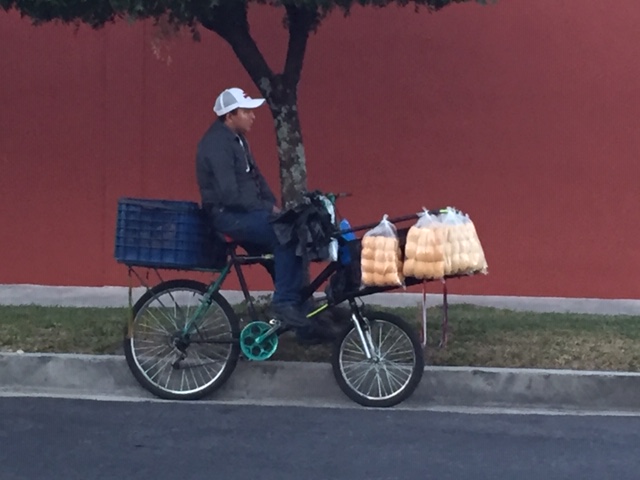
This is somewhat self-explanatory, but it's also very Salvadoran.  One of the first three horns or bells you'll need to learn in the neighborhood is the clown horn call of the dinner roll boy outside your door. (The other two are the cow bell from the garbage truck and the doorbell of the water vendors.) Sometimes on a motorcycle, but more often a bike, they cruise by in the morning and evening selling exclusively white bread rolls - square or hot-dog shaped - from their oversized baskets or hanging from bags off their handlebars. Keep in mind this is a mountainous country with only the coastal stretches of land making for easy, flat biking terrain.  These guys also fall under the previous category, and I like the cross-over with number seven, too. 

15. A really bad idea. 
The last of our open-to-interpretation categories. I attribute these activities to the theory of alternate physics.  That is to say, it may be dangerous to ride on top of an unsecured stack of pipes in the back of a pick-up in the U.S. - so it's illegal there.  But in El Salvador, where there are alternate physics, this is perfectly safe and therefore a common habit.  Don't think too much about it, just enjoy the ride.

Scroll through the pictures below for your own Salvadoran Bingo experience.  While many images will be self-evident, I'm certain that something I penciled into the "really bad idea" category will be someone else's "something that makes you smile" - that's what makes it fun.  There are more than 15 photos to give you multiple examples of some categories.


P.S. After writing, but before posting this, my husband and I went on an afternoon drive to a town about 30 minutes from our house.  We covered all but two of the Bingo squares (no peeing person and no wandering minstrel).