Showing posts with label Road Trips. Show all posts

Friday, October 31, 2025

Road Trip to Retirement: A Drive to Reflect

Note:

This is the story of our final road trip west as we leave Virginia and DC and put our Foreign Service life in the rearview. 

This journey allowed time - a LOT of time - to be struck by and to reflect on how this career shaped me, what it all meant, and what we're heading towards. 

The Final Pack Out

How can it possibly be so mentally and physically exhausting to watch other people, six to be exact, wrap and pack every thing we own while we sit and watch? Grab thing, wrap in paper, put into a box, repeat repeat repeat. Without hesitation, the packers recognize what needs extra protection, whip out a box cutter and custom slice a cardboard sleeve to protect a bit of the whatsit that sticks out. Squeeeeal goes the packing tape as it's pulled off the roll, securing the cardboard wrapped around the wooden coat rack, and the ceramic planter we picked out in Juarez, and that odd shaped carving from Romania. Again and again. It's a disturbing noise that echoes through the steadily emptying apartment. They wrap the furniture last in heavy quilts pulled from an enormous stack that two of the guys brought up draped across the back of their necks from the moving van. Cobijas they call them - blankets - which sounds quite cozy for the furniture. 

This is our 11th pack out and we go through the motions on muscle memory. This move is different as everything we own is being packed up. There's no spare room we can hide out in, reading or napping on whatever furniture will stay behind. Now, the more they pack, the more the ground beneath our feet is eroded away until there's nowhere left to sit or stand that's out of their way. I'm left leaning against the living room wall like a mop. We've moved the two cats, suitcases, and any necessities we could squeeze into the car to a cheap motel across town for our final nights. From under the motel room bed, the cats are oblivious to the dismantling of all they're familiar with. It's hard enough to take in for those of us who understand.  

By 5:15 the swarm of locusts has emptied the apartment, and the moving van and crew are heading back to Maryland where the van will be unloaded into a warehouse. We're left with a box of cleaning supplies and a broom I'll leave behind. I sweep up the detritus on the floor: bits of cardboard, tape, and cat hair tumbleweeds finally freed from behind the bookshelves and tumbling across the living room. I also sweep away four years of our lives spent in this apartment and say goodbye to the 75 foot willow oak trees, the reach of their branches filled our windows and comforted me from my bed each morning. It's time to move on again.

On March 8 this year, I decided to leave the Department and the career I'd considered the professional high watermark of my life. Beyond the work, and in fact more than the work, our Foreign Service life brought my husband and me friends and adventures we would never have known if we had stayed in our small Western Washington town. And now all I can do is count down the days until we pull back into that little town: 37 to be exact. Besides the two of us and our two cats, the fifth character in this story is our car, our faithful 2011 Ford Escape bought 13 years ago. It has accompanied us to three of our overseas posts, including making cross-country drives to and from Mexico. It's easy to fool myself that this is just another vacation, another adventure - but it's not. This one is indelible. 

I feel I'm turning my back on a place I no longer recognize and can't bear to see in ruin, averting my eyes before the building collapses. The State Department that hired me in 2011 is currently a hand puppet of its former self with someone else's hand up its backside, making it say things it doesn't believe, that are contrary to its values, yet is impotent to stop. I feel some shame for not sticking it out as my colleagues are, doing their part to keep the nose of the plane level. However, even stronger is the feeling that I'm turning towards something I've been longing for: a quieter life, a more outdoors life, a life under my own direction and creative control where the standards used to evaluate myself, my worth, and my capabilities are my own. 

Road Trip Day 1: Arlington, VA to Streetsboro, OH

We are concerned about how the cats will be in the car for more than a short trip, their car experience thus far. Fortunately, they're doing very well and it seems we may have won the traveling cat lottery with no peeing, barfing, or yowling. But it's only day one. We put their carriers side-by-side on the folded-down car seats with a litter box, bowl of kibble, and potted catnip plant in front of them. A little opium den to keep spirits mellow, if you will. I open their carrier doors and twist around in my seat to observe. Seamus cautiously steps out and begins to sniff around. Bridget curls into a cinnamon bun and tells us to wake her when we're there. 


We leave Arlington, then Virginia, then Maryland, and hit Pennsylvania by lunch, Ohio by late afternoon. Our refueling and lunch stop is a no-souvenirs or postcards kind of truck stop that doesn't even have picnic tables. We can't leave the the cats in their car while we tuck into Reuben sandwiches and side salads in the diner. Instead, we stop along the edge of the parking lot and raid our cooler. Ham sandwich and apple in hand, I hop the guardrail and scramble up a grassy hill to sit under a lone tree. Better.

Pennsylvania is green, very green, with corn fields lining both sides of the interstate, punctuated with huge white or red gambrel barns and tall, silver silos. I had a wooden farm set like this as a kid where I could rearrange the pieces across a blanket printed with fields, lanes, trees, and streams. The resemblance astounds me and the memory makes me wistful for those easy days.

I'm so concentrated on the landscape zipping by the window that it's easy for me to forget we're leaving places we've called home for many years. In our 14.5 years in the Foreign Service, we've spent nearly six in Virginia, between two domestic assignments and many training stints. Virginia has always been a "see you later" place, but this time is different. We may not see you later. Our friends there now, like us, also may not be there forever. I ease myself with promises of catching up with them elsewhere and wash it down with a good dose of denial. After all, we're used to this routine: pack up, say goodbye, move on, unpack, figure it out, settle in, hit your stride, pack up, say goodbye, move on. 

Lather, rinse, repeat. 

By early evening we pull into Streetsboro, OH, not far from Cleveland. It's our first of many questionable motel choices where I won't be walking barefoot on the carpet, but it's sufficient for the night. With the car unpacked and the cats once again hidden under the bed, we leave to find dinner at one of many strip malls off the broad boulevard fronting the motel. Tonight will be BBQ sandwiches and eavesdropping on conversations from people in Ohio State sweatshirts. It's Saturday and OSU has scored a big football win; spirits are high. Folks are setting down their beers to throw axes at targets at the edge of the dining patio and toss beanbags into cornhole boards - things I'd be really bad at.

So is this what regular folks do? Are these our peers now? 


Road Trip Day 2: Streetsboro, OH to Elk Grove Village, IL

Ohio farms are beautiful and lush and look prosperous. We appreciate also that the turnpike tolls can be paid in cash to friendly toll takers in toll booths, imagine that. Pennsylvania and Illinois aren't as obliging and I start taking notes on how to pay these tolls online after the fact. We cross the top of Indiana which, despite my esteem for Pete Buttigieg, I find visually underwhelming. But they also let us pay tolls in cash, so we forgive them and keep moving on. 

On the western outskirts of Chicago we pull into another sketchy motel whose name ends in a number and unpack the cats and car. This takes close to an hour each morning for pack-up and each evening for unpack, 18 times for this trip. Urgh. But we're starting to develop a system and haven't yet locked the keys in the car or left anything/anyone behind. In a pre-dinner wander, I find a serene little pond beside the motel, wedged between the rush-hour interstate and a row of industrial warehouses, directly under O'Hare's flight path. I sit on a bench under a willow tree and watch a white heron wading in slow-motion in the shallow water. With this, I pretend it's pretty nice. 

We were excited to have dinner plans with a good friend from El Salvador and his family. He and my husband worked side by side in the Embassy for three years, laughing and ribbing each other like brothers. Our friend is a dual U.S.-Salvadoran citizen and with his wife now a green card holder, they made the difficult decision to leave tropical El Salvador for the cold winters and steamy summers of urban and expensive Chicago with their young children. His consular experience as a locally employed staff member was key to getting a good job with USCIS. With pizza slices in hand, we listened to his stories about interviewing asylum seekers from around the world. My consular heart grew two times bigger just hearing his experiences and we peppered the conversation with immigration form names and numbers and INA sections. I spent so many years marinating in this world, keeping on top of changes in law and processes, I wonder if that part of my brain will just dry up from neglect? Will this body of knowledge become like that once-loved dress in my closet that is now uselessly out of date and size?

Road Trip Day 3: Elk Gove Village, IL to Rochester, MN

This day takes us through a long stretch of Wisconsin before our overnight in Rochester, Minnesota. Wisconsin: America's Heartland! Why not America's Stomachland? No shame. That's really what they specialize in, with that uninterrupted horizon of fertile farmland dedicated to filling my belly with dairy delights. It's quite beautiful and early September offers a very hospitable climate to boot. 

I insist we detour through downtown Madison to relive a fond memory from the summer between my junior and senior years in high school. My father took me on a college campus tour of the Great Lakes region and in just a half-day visit, I became enamored with Madison and it's lakeside purview. My memory is shaky as to why I didn't apply to become a Badger, but likely they didn't offer the degree I was considering. Cruising through downtown and an unending horizon of university buildings a few decades later, I fall for the city again. I start to wonder what path my life would have taken had I gone there instead. We have a quick tailgate lunch overlooking one of the lakes with the cats staying cool in the shaded car and agree we could live here. Ask us again in February. 

State capital and city lakeside skyline

Two hours north of Madison, I-90 bends to the west and delivers us across the Mississippi River and into Minnesota. We pull into a manicured rest stop along the mighty river for a look around. I stretch my legs on a walking path leading to the water's edge and meet a neatly dressed man in a polo shirt buttoned to the collar, his fishing rod and tackle box carried in both hands. Unable to resist engagement with a safe-looking stranger, I break the ice with the typical "Soooo... what are you catching these days?" I've forgotten his reply as instantly I zero in on his accent; it's a bit of a compulsion, I'll admit. Central or Eastern Africa, for sure. More fish questions and finally I have to confirm my guess about where he's from. I learn his name is Vernon and he's a truck driver here in Minnesota, but says he's originally from Zambia. "From Lusaka?" I ask, his face registering great surprise and then a broad smile. "Yes!" We chat another beat and then I wish him good fishing and safe driving and we part ways.

I recognized Vernon's accent from 2022 when I had been offered the Consular Chief job in Lusaka, Zambia. My husband and I were excited at the prospect of the new adventure and a chance to return to south-central Africa. (I'd backpacked through the region in 2002 and my husband was a Peace Corps volunteer in the nearby-ish Central African Republic.) I gave my husband Zambian guidebooks at Christmas and we began listening to Zambian radio station streams, getting used to the accent, rhythm, the local phrases. It was about then that a voice inside me cleared its throat and quietly questioned how much longer I wanted to continue in this career. It was a voice I had been trying to ignore or rationalize away recently. With a plum assignment in hand to a coveted country - what was the issue? The issue was that I was following someone else's career plan, not my own. When I was honest with myself, this next logical step in my career progression was a bigger job than I wanted. I saw myself run ragged to keep up the guise of polished competence, work phone in hand or always in reach during off hours lest I miss something and respond later than immediately. I didn't see a place for the explorer, the stranger engager, the sometimes silly and occasionally inappropriate storytelling creative type that is ME, my default setting. I broke the assignment seven months before we were due to arrive. The pure relief I felt after being released from that job put the taste, like a drop of an illicit elixir, of freedom onto my tongue that I would savor for the next three years. 

Until today, I had never met a Zambian in the United States - why now? Was his presence on that riverbank purely coincidental or meant to remind me of that epiphany from 2022 and to reassure me that I was on the right path? Perhaps the latter, but it also made me regretful of a road not taken and melancholy about a country we would never serve in. Why does everything have to have a flip side?

We hit Rochester by early evening and find our nicest motel so far. As I'm complimenting it, I'll say its name: La Quinta Inn and Suites. Clean, modern, friendly, great staff, full breakfast, clean carpets and they give us the largest room in the joint. I think we could move in and the cats wouldn't mind. The location is uninspiring: near the interstate alongside a commercial plaza with grocery stores, a Toyota dealership, and close enough to grab some dinner without making the car move any further than necessary. Not scenic, but practical. 

Road Trip Day 4: Still Rochester

The morning's weather forecast is predicting rain for our drive today, the first we've had in a very long time, and we have a long stretch of middle-of-nowhere ahead of us. My husband reminds himself that he needs to change the wiper blades on the car and heads out to do so while I see what's on offer in the breakfast room. It's a pretty good spread, better than we've had so far for sure. I notice mostly older couples in the room, cups of coffee or orange juice in hand while they wait their turn at the automatic waffle maker. Then I notice the sign for the free shuttle from the hotel to the Mayo Clinic and my impression of our fellow hotel guests softens in empathy. I'm finishing my scrambled eggs and a second cup of tea when I realize it is taking my husband an inordinate amount of time to change out the wipers. Hmmm... Moments later, he finds me in the dining room and strides directly to my table, moving like a guy who has something important to say or do. I set down the plastic fork. 

Using a measured voice that is equal parts "I don't want you to worry" with "Let me be clear that this is not good but I'm taking care of it" he tells me there's something wrong with the car and we've got to stay another night. He found the car with a piece of the undercarriage hanging down and an impressive puddle of...fluid? drained over the right front axle. 

"I've taken it next door to the Toyota dealership and they're going to look at it and let us know. They're going to try to squeeze us in by noon." Understood. Taking up my fork, I scarf the final bites of now-cold eggs and transition into our unspoken division of labor: he takes care of mechanical stuff; I'm on lodging, pets, and provisions. The kind front desk clerk rebooks us into the same fancy room for a second night and for some reason the rate has gone down a few bucks. 

I've always been lucky in my bad luck, and having this happen 100 yards from a dealership, while we're ensconced in a nice hotel with a cheap rate, the cats having fun in the spacious room, and walking distance to a grocery store - we really couldn't complain. We did, however, just a bit when the damage was relayed from the dealership. A splash guard had come loose and fallen onto the CV axle boot, rubbing a hole in it and letting all the lovely lubricant ooze all over everything. No bueno, but a half day and $900 bucks later and she is good to go. We now have a day to rest and with a steady rain falling, it seems only prudent to visit the hotel's indoor pool and hot tub. 

We are joined in the hot tub by large Thad, a bearded and tattooed 31-year old from North Dakota here for diagnosis of something unknown with his heart. I know these details, as he tells us outright. Despite his circumstances, he's a jovial and open guy and the three of us chat in the hot tub longer and to a far more personal level than we anticipated when we swung our towels over our shoulders and walked towards the hot tub. 

"It's the Bakken that did this to me." 

"Come again?" I ask.

Thus begins a fascinating description of the vast area covering much of the U.S. northern plains and two Canadian provinces, the men that work in the oil and gas fields there, and the things they do to themselves to keep up with the 60-90 hour work weeks of intense labor. We agree with his speculation as to the cause of his heart condition. He's fortunate that he has a wife and two daughters willing to settle there and soften his life in what sounds like a post-apocalyptic wild west. He's young, strong and we wish him the best care. I regret regaling him earlier with our tales of "but it's all fixed now" mechanical woe.

Road Trip Day 5: Rochester, MN to Chamberlain, SD

We're back in business and I take the wheel for the first half of our drive across the rest of southern Minnesota and into South Dakota. Of all the segments of our trip, this is the one I'm looking forward to the most, as South Dakota is the only state in the continental United States I haven't yet visited. Besides, we're booked to stay at a funky mom-and-pop motel alongside the mighty Missouri River and the state has some pretty awesome sights we plan to hit tomorrow. Two hours west of Rochester, the scenery looks like this:


And then like this:


With the smooth sailing, Seamus occupies himself surfing the roof of his carrier as car captain. Bridget reminds us to wake her when we get there.


Three cups each of hot beverages, as enjoyable as they are with breakfast, have their side effects, and two hours into the drive we agree to pull off at the next rest stop for a bathroom break. The off ramp is a sweeping right-hand curve and no sooner had I decelerated and started the turn than a god-awful screaming, squealing metallic noise assaulted us from the right front wheel area. Yes, the very one that was just repaired. I shut off the radio to make sure the noise wasn't just an ill-advised artistic choice in a song. Nope. We look at each other with matching "OH SHIT" expressions and I bring the car to a stop in the wide parking lot, sized for the semi-trucks that are the only other occupants. 

We drive the car in slow figure eights to diagnose when and from where the noise is coming. There's no town in sight -- and we can see for a really long ways. Thankfully there is cell service and online I find two likely repair options 40 miles either this way or that way. Picking randomly, we get back on the interstate and head for one. Knowing my husband will be physically stronger and more level-headed should the front half of the car fall off at 65 mph, I take the passenger seat. Meanwhile, he suggests I search YouTube for help on "what to do when you've just installed a new CV axle boot and your car suddenly makes a horrific noise while turning." Miracle of miracles, the first video I click on just happens to address our exact predicament, including a recording of the noise we heard and a sharp, clear-spoken narrator guiding viewers through the repair. My husband pulls off the highway at a graveled wide spot, studies the video, jumps out of the car, and without hesitation slides onto his back under the front end. Following the sage advice to the syllable, he FIXES THE CAR with his bare hands. Noise gone, car moving perfectly. Away we go again! Bridget doesn't even wake up. 

I am silly with relief and sing along with an old '70s song on the radio, changing the words to fit the setting: "Corn to the left of me, soybeans to the right; here I am stuck in the middle with you" and thank my stars I married a practical man. 

There are still a few hours of daylight left when we hit Chamberlain, SD and park in front of our room in the charming-and-as-funky-as-expected A Bridge View Inn. After unpacking and settling the cats, my husband grabs a pillow and I grab my camera to stroll along the lazily moving Missouri, taking in the motel's namesake vista. It's a generally quiet town, but especially now as we later learn from the 17 year old waitress as she takes our dinner order. They're between fishin' and huntin' seasons, but soon - this place will be rockin'! Seeing the giant truck-and-boat parking lot and adjacent overflow lot - we're inclined to believe her. 

I wonder what life here is like and picture myself on the porch of one of the Victorian houses we pass on the walk home from dinner. Right now the slow pace feels soothing, but what about the following week? I have a sneaking suspicion that the level of stimulus I've grown accustomed to has set my engine idle far too high to be satisfied in this environment for long, plus I'm not much of a hunter or fisher. The next morning I stare at the sunrise reflecting off the bridge while sipping tea from a paper cup and feel satisfied to be moving on. 


Road Trip Day 6: Chamberlain, SD to Gillette, WY

It takes just under two hours of driving due west for the topography to change dramatically. The first indication that the plains are giving way to something else comes in the form of jagged bluffs appearing suddenly on the horizon:


The Badlands sneak up on us, not because we don't know they would be there, but because we've had only gentle undulations beyond the windshield since we left Virginia. Seeing them growing in height and focus in the distance speaks clearly to me that we are certainly in The West. Apparently crossing the Mississippi and then the Missouri Rivers weren't clues enough of this much-anticipated literal and symbolic transition; the scenery now looks like the Wild West and it's undeniable we are nowhere near DC and all that comes with it. We pull into the Badlands National Park and stop at the first viewpoint. The raw, eroded peaks look as if someone turned the grassy plain inside out, showing us what should normally be under the surface. From the highest overview, we wind down to the valley floor and see the same peaks from ground level on the immersive 39-mile park loop road. 


The day has more wildness in store for us as we curve up and around the South Dakota Black Hills, through infamous Sturgis, and wind through the piney woods to find Devil's Tower, our first stop in Wyoming.  


The wind had been battering the car most of the day and amped to an alarming velocity as we entered the high, dry plateau of northeastern Wyoming. We find our hotel in downtown Gillette and begin the unpacking and stuff-shuttling routine. I accidentally litter a stack of napkins from inside the car as upon opening the door it is ripped from my grip. The napkins are vacuumed instantly across the street and out of sight before I can even react to grab them. Everything around us looks tough and this is clearly a testosterone-centric town and economy. From the roughnecks that work on the oil and gas rigs, to the coal and uranium miners, to the ranchers stringing barbwire in this wind - and snow - Wyoming means business. It has no room for people who whine about littering napkins or pick their navels about no longer being diplomats. 

Road Trip Day 7: Gillette, WY to Livingston, MT

The prior night's winds are temporarily abated and we hit the interstate once again, this time heading north through the corner of Wyoming and into eastern Montana. Like Texas, one doesn't drive through Montana in one day (at least we don't), and so we aim to make it to just north of Yellowstone Park today, home to the most expensive cheap motels of our trip. 

From the passenger seat, I send a friend in DC a few photos and updates of our progress thus far. I include a snap of last night's sunset, taken as we waited to cross the street on the way to dinner. 

"Beautiful, but do they not sell sedans in Wyoming?" she asks.

"Sedans are for pussies or Commie liberals." I add.

"And vegetarians."

We have a good emoji laugh, but I acknowledge that the further west we get into these wide-open spaces, into the pine, sage, and cow-poop smelling countryside - the more soothing the trip becomes. I ask how she's adjusting to her new assignment, her first inside Main State, aka the State Department's headquarters in DC. 

She responds, "Surely (your trip is) more fun than having to think about what could possibly be in your work email every morning. Smelling cow poop sounds divine to me." 

With that, my stomach clenches just remembering how I felt at work more often than not, and particularly when summiting the steep learning curve of a new assignment. That dread of knowing there's more work to be done than time in the day, not including the regular injection of tasks from some higher office, usually with tight deadlines and little guidance on how to accomplish them. The environment kept my pot of anxiety continually on slow simmer, bubbling away. Some folks thrive under this kind of pressure and relish the challenge of training with live ammunition. I'm far too risk-adverse to be one of them. My last ambassador, while making his rounds through the embassy once said, "This is the best job in the world. If you're not having fun - something's wrong!" While I appreciated the reminder of the really cool things we did indeed have our hands in, it was the last part of his declaration that worried me. Was there something wrong with me that I wasn't always having fun?


The five-hour drive through the upper right corner of Wyoming and a good stretch of Montana brings us through towns and cities whose names I recognize from Kevin Costner and Robert Duvall movies. To our distant west, we begin to see what I'd been waiting for: real mountain peaks on the dusty horizon. When I couldn't get them into focus, I first blame a dirty, bug-spattered windshield. Then I rub my eyes and adjust the exposure on my camera, but nothing brings those peaks in sharply. Finally, we realize it's wildfire smoke throughout the region that is blurring the view. Unbeknownst to us at the time, this smoky horizon would be something we'll contend with for the next five weeks. Welcome, and get used to wildfire season. 


The Yellowstone River - our companion for many miles


Livingston, MT


This wasn't the first time I'd taken a leap of faith in my life by heading west. In fact, it was the third.

The first time was a year after college. I was living in New York City with three friends in a one-bedroom apartment and commuting to an entry-level job at a Wall Street travel agency in my own version of Melanie Griffith's late '80s "Working Girl" in tennies and ankle socks and my career girl suit. After just a few months, the "check engine" light on my soul came on and I quit the job, ditched the suit, and got hired over the phone to be a wrangler at a guest ranch in Colorado, sight-unseen. 

The second time was after another college graduation, this time with an Equine Studies degree spurred on by the Colorado ranch experience. I got on the Amtrak in Boston and got off in Spokane, WA to start a job at a horse training and lesson barn. Each of these moves west were made with an unwavering instinct that I was both doing the right thing and was going to be okay, despite the long list of unknowns. Gazing out the window at Montana's unmistakable "western-ness," I was struck by the parallel and while choking back tears, concluded that this time, too, I had made the right decision and all would be okay. 

Road Trip Day 8: Livingston, MT to Haugan, MT

Last night's sketchy motel does not live up to the adjective that is the first word in its name. In fact, the only thing super about it is the super-sized room rate, given our location at the gateway to Yellowstone. (It's a long gate, btw, as visitors are still an hour's drive to the park entrance.) In the morning, nearly $200 later, we pack up once more and drive five hours deeper into the wildfire smoke to one of those roadside attraction motels whose signs taunt drivers for hours before they arrive with promises of silver dollar winnings at their casino and all the pies and souvenirs you could want. It does not disappoint. Even the cats agree, as the lovely woman at the front desk gives us a basket of cat toys and treats and their own blanket for the pleasure of staying. All this and pie, too? I vow to buy something from the gift shop. 

Road Trip Day 9: Haugan, MT to Manson, WA

Over a hearty breakfast including basketball-diameter pancakes whose calories I certainly haven't earned sitting in our car for a week, I gaze out at the evergreens surrounding the restaurant and get wistful again. There has been a lot of that lately. I remember a conversation with a dear colleague in El Salvador. She was in my office one morning and I was recounting the details of some day trip my husband and I had taken and showing her my photos when she smiled and stepped back. 

"You don't want to do all this," she waved a hand around my desk and office.  

"You want to do THAT," she pointed to the photo on my computer. 

Her comment silenced me. I knew she was right, but I couldn't say it out loud yet. However, I was secretly thrilled that someone else had recognized it, so it must be true. 

Back on the interstate, we pass an important milestone:


Followed by a brief dash across the narrow bit at the top of Idaho:


We are not only in the west, but specifically the Pacific Northwest with all its pine, fir, and cedar-scented goodness. With its moss-covered trees and steep grades on the interstate. I choke up a bit again as we cross into Washington and are surrounded by cars with Washington plates, guys in Seahawks jerseys, and exits for towns I've visited. Otis Orchards, Spokane Valley, Airway Heights, Davenport, Grand Coulee. We'd made it. No more saying Washington STATE when asked where we're from. No more explaining where we plan to retire, "Oh, you won't have heard of it; it's a little town 27 miles north of Seattle." 

These are our peeps and this our state. We're home. 

Freshly harvested Central Washington wheat fields


Well, almost. 

First there is a little matter of one month to kill as we wait for our tenants to move out of our house. We have rented an A-frame cabin along the shore of Lake Chelan, surrounded by an apple orchard. The sinewy, 50-mile long lake is tucked into the eastern slope of the Cascade range that divides the big cities, mossy, damp, and evergreen Western Washington from the drier, agricultural heart that makes up the other two-thirds of the state. We bring the cats in from the car for the penultimate time and introduce them to their first set of stairs. Bridget takes to being a loft dwelling lioness immediately; Seamus hides under the downstairs bed for a few days before gaining his courage to explore. The month passes with a routine of morning yoga and walks in the orchard, afternoons sitting on the dock reading or tossing a line into the lake, slicing apples for maybe too many apple crisps, and definitely too many days on the phone going through the bureaucracy of reinstating our civilian lives in Washington: insurance, car registration, utilities, changes of address, finding doctors and dentists, and even a wee bit of job searching. The wildfire smoke continues to plague us with air quality indexes occasionally matching Delhi or Beijing, and then with a wind shift - leaving us with crystal clear views of our stunning surroundings. 

Our temporary orchard home


Road Trip Day 37: Manson, WA to Snohomish, WA

With final goodbyes to the cozy cabin and its lake view, we pull away from the orchards and hit the highway for the last time. Although we know the route all too well from living in Washington for decades, I turn on "lady" (what we call Google maps) to get a drivetime update. 
"Due to wildfire closures on Highway 2, your route may be affected. There are no alternate routes." 

Translation: You can't get there from here. 

Ummm.... WHAT? There are only so many passes over the Cascades and we know access to one is already closed due to the fires, and now she is saying our planned route is closed with no alternates, not even the far northern pass that would double our drive time?! Nooooooo!

With my husband at the wheel, and reminiscent of my frantic googling in Minnesota for car repair options, I search official sites to verify her dire prognosis. She was wrong; Highway 2 is NOT closed. Phew. And damn you, lady!

We wind our way out of the eastern foothills and up into the evergreens, their undergrowth a crimson carpet. 


At exactly the crest of Steven's Pass, as we begin to descend, the first raindrops hit the windshield. Welcome to Western Washington.

The valley floor flattens at the first town with a funny name, Index, followed by Gold Bar, Startup, and Sultan. The highway parallels the meandering Skykomish River into Monroe where it joins forces with the Snoqualmie River and becomes the Snohomish River -  the tribal namesake for our town and county. For both of us, this is familiar stomping grounds and we comment about what looks the same, point out what wasn't there before, and rely on each other's memories about why do I know Old Owen Road? 

Finally, we exit the highway.


That afternoon we pull into the driveway of our own house and the property manager meets us to return the keys. We unlock the front door and step into the house for the first time since we bought it years ago and turned over the keys for her to rent out.  

And just like that, we return to our regularly-scheduled life, already in progress. 

Final Thoughts

I hold my years in the Foreign Service as the most personally and professionally challenging period of my almost six decades of life. Without the educational or work experience that typically leads to such a career, it was only by dogged determination and a summer of studying that I got there. With my husband and our original three tabbies in tow, then our two new kitties, we had adventures and experiences that gave color, texture, and excitement to our lives. We made wonderful friends, heard fascinating stories, learned languages, and along the way absorbed more about our own country and four others and foreign relations than I'd ever have anticipated. (I still love to geek out on all things immigration law!) I was tenured and promoted twice, but damn it wasn't an easy ride. The mix of adrenaline, accomplishment, and gratitude I felt for simply being selected and trusted to represent the country carried me through the inherent stress of being continually in movement, being on some section of the learning curve, always changing and adapting, rarely resting. But all the while, I felt I was wearing someone else's suit, a uniform I was proud to wear that garnered respect and credibility, but didn't feel like my own. 

It's now time for a new chapter and my own set of clothes. 

Sunday, June 26, 2022

Guatemala: Experiencing a New Old World

Antigua - NOT Cara Sucia

Cara Sucia and a Border Crossing

Land border crossings should be approached with a bit of trepidation, in my opinion, and not just by smugglers. Any crossing is steeped in the real possibility of not being allowed to exit/enter or inadvertently committing some border or customs infraction and being turned back - or worse.  Even certain I'm innocent of any wrongdoing, I feel apprehensive making the final approach and presenting myself and my passport for inspection to the border authorities. Holding all the power, they know you want to get somewhere and know they control whether or not that happens. Under stress, I'm guilty of offering too much information. 

"Hi, we're just visiting your country. Really looking forward to it. Yeah, just there for nine days and back. Just me and my husband, no pets. We're careful drivers, don't even smoke, hahaha, oh, but we did bring some sandwiches for the road, and some... ummm... apples? We figured that was okay...?" The lady doth protest too much will only draw suspicion so I try to follow my husband's lead instead. 

Reason for travel? Tourism.  

It takes restraint over every fiber of my being to be this succinct. 

There is also a wild west frontier feeling to border towns that attracst a different type of person, people who prefer to live close to the edge, as it were.  Smugglers meet smuglees here, goods are exchanged or concealed - there's stuff going down that you can almost smell in the air. The La Hachadura crossing heading westbound from El Salvador to Guatemala is no exception. The last town before the crossing is "Cara Sucia" (Dirty Face). A town has to live up to a name like that and Cara Sucia does so by being dusty even in the rainy season. But you can find everything here, far more than would be expected from a town its size. Beyond the usual small goods, you can also have your pick of colors of Cinderella gowns, upgrade to a new stove, find a payphone that still works, or a few dozen guys with motorcycles, bikes or just wheelbarrows willing to shuttle you/your stuff across the no-man's land between the two countries. In the case of La Hachadura, that means over the Rio Paz (Peace River) and into Ciudad Pedro de Alvarado, Guatemala - but don't expect to see much of a ciudad there. 


Shortly after leaving Cara Sucia, the line of semi-trucks parked in the right lane begins. That day it was five miles long. Fortunately we'd been warned that we didn't need to wait with the trucks, but instead were told to just pass them by driving into oncoming traffic in the left lane. It's simply understood this is what folks do. What wasn't fully understood was whether or not we should tuck as far right as we could against the big rigs in our own lane to let oncomers pass, or heed the frantic hand gestures of one particular driver staring us down head on and swerve across their lane onto the left shoulder at the last second. So we did a bit of both, depending on what seemed the best option at the time. This is what I mean by a wild-west frontier feel. Anything goes. 

One must understand the premise of land crossings: get stamped out of the first country and then into the second, often traversing a bit of no-man's land in between. Knowing this is key as one could very easily blow right past the row of low, semi-governmental looking buildings and continue into the next country only to cause the inevitable kerfuffle on the receiving side when there is no evidence in your passport of an official departure from the first country. We kept a lookout for a likely person/place to direct us and found him standing in the middle of the road in a uniform of sorts. Asking him what we needed to do, he looked around the rather unorganized collection of trucks, motorcycles, and pedestrians and waved us towards a puddly spot to park. From the general uncertainty of the man's directions, it seemed we were the first passenger car to go through this routine. I would've thought otherwise. From there we joined a small line of foot-crossers or those unloaded from buses waiting to see immigration. 

Now comes the Diplomatic versus Personal Passport Dilemma, an evergreen squabble between my husband and I. Since being hired by the State Department and given our first official black passports, we've had engrained into our psyche that ONE DOES NOT USE A DIPLOMATIC PASSPORT FOR PERSONAL TRAVEL. Fine, fine, no need to shout. However, if said diplomatic passport contains one's visa and entry stamp into the host country, and then on personal vacation one presents a pristine tourist passport containing no evidence of ever having entered the host country - so how could I now be leaving - it tends to make border authorities rather cranky. Worse, if after watching the border agent type your name into their database, search, flip through all pages of your passport, re-check the spelling of your weird American name, type again, re-check the birthdate, and finally call over a supervisor to whom you then helpfully say, "Oh, but I have two passports..." they tend to get even crankier.  Therefore we carry both passports all the time and let them sort it out. 

After just a short wait, we got stamped into Guatemala and were on our way. Woohoo!  About a mile into this new country we hit our first police and military checkpoint. We're no stranger to these in El Salvador and generally upon seeing the diplomatic plates on the car, we're promptly waved through. Not so today. My husband stopped the car and handed his tourist passport and Salvadoran ID document through the window to the uniformed officer. He flipped through it lazily, more as a matter of habit than actually seeking information. I offered mine towards him and he dismissed it and me with a wave as if I'd offered him a crying baby. 

"We're out here working (wipes brow) in this HEAT, looking for Bukele's pandilleros - las maras - you know?" He said in Spanish referring to the Salvadoran president who has currently incarcerated tens of thousands of suspected gang members, perhaps causing thousands more to flee to neighboring countries until the smoke clears. 

"Just working in a corrupt country, for a corrupt president. Where you from?" He still held my husband's passport.

"We're from Washington, the State of Washington."

"Ooh - Washington."

"No, the State of Washington, not the capital. It's over by California, near Canada..." 

"Hmph.  Cold up there?"

"Sometimes."

"Yeah, I'd like to go to the U.S. right away, but I'm here working in this HEAT..."

He let the sentence trail off and lifted his gaze to take in his surroundings and the group of bored and heavily armed soldiers manning the checkpoint in the shade of an enormous tree, still holding the passport and tapping it against his palm.  

I'm not sure if he was expecting us to open the back door and offer him a lift somewhere towards the U.S. or just pass him a little something-something for his trouble - in the heat and all -  but when we did neither and instead sat there smiling at him, he relented, returned the passport with a sigh and waved us on.

The Climb Towards Lake Atitlan

The route towards our first destination, the enormous, volcano-ringed Lake Atitlan paralleled the coast inland where it's still steamy and flat, and then turned north and began to wind into the mountains, quickly gaining altitude. We pulled off the road at a shady spot along a river, surrounded by agriculture on one side and the bases of mountains, their tops shrouded in heavy mist, on the other.  My husband pulled out sandwiches and drinks from the cooler in the back of the car and without a place to sit that wasn't the car, we stood to eat.   


An elderly man carrying a large sack stuffed with firewood and hung down his back from a strap across his forehead shuffled towards us up the road. He backed up to a large bolder and let the weight of his sack rest on the rock, slipping off the forehead strap. I remember doing just that with my overstuffed backpack while traveling and recall the instant relief of something else bearing the load - even if just for a moment. Unlike us, he didn't pull a sandwich or water bottle out of his sack, but just rested to catch his breath.  

We greeted him and I asked if he lived nearby. I was thinking we should give him a lift, wherever he was going. He responded with a flick of a hand to indicate just up the road at the finca (farm).  

"Oh, do you have your own land there?" I was hopeful. 

"No, we all just work the land for the farm. But now I'm too old to work. I'm 71, and no work means no..." he gestured his hand towards his mouth and it's clear he meant no food. My husband pulled out a can of sparkling water and an apple and gave them to him. The man smiled gratefully, cracked the can open and took a long pull before looking to see what we'd offered. After his swallow and an involuntary brow furrow, he tilted the can to read what the strange drink was. Unphased, he drained the can and started into the apple. Finished with our stand-up picnic, we said our goodbyes, got back in the car and prepared to leave. Looking us straight in the eyes, he wished us a safe trip and blessed our generosity. Less than a quarter mile up the road we passed the farm where he lived and used to work. I wondered where the rest of his family was and why they weren't feeding him. 

About 40 minutes of winding roads later, we began to plateau at the rim of the giant volcanic caldera. From there we caught our first glimpses of the great lake below. There wasn't much room to pull off the road and take in the view, with steep drops on one side and sandy, eroding embankments dotted with small landslides on the other. The potholes on this stretch of road were remarkable and my husband was doing his best to swerve around them. We rounded a corner and had to brake to a crawl for a man with a shovel full of sand and dirt apparently filling in the potholes from material he'd dug out of the side of the embankment. It was Monday, a work day, so my first thought was that he was part of a road crew, but it was strange there was only one of him, no warning cones, and he wasn't wearing any identifiable work-crew type vest.  

As we passed him, he came to the driver's window with an outstretched hand. We heard the word "coins" as we drove by, realizing only too late that he was filling the potholes for spare change from passers-by. Two curves later and we came across a mother and three children who popped up from the depth of a sandy pit on the shoulder where they'd dug for material to also fill the potholes. The youngest, a boy of about three years old, had a tiny plastic shovel and bucket, the type kids take to the beach to make sand castles. My husband remarked that he was learning his trade early. I noticed the scrape marks on the sand embankment where the family literally had been scratching out a meager existence, like prisoners trying to escape their situation. 

Looking down onto Panajachel.


Panajachel - City on the Lake

From the rim of the caldera, we then dropped down to the lake shore city of Panajachel. Although far lower than where we'd just been, it still had an altitude of 5,239 feet. We were now in the western highlands of Guatemala and firmly inside Mayan lands. The name "Maya" is a collective term for the indigenous people - millions still - ranging across southeastern Mexico and the Yucatan Peninsula, Guatemala and Belize. Lake Atitlan gained notoreity on the backpacking circuit in the 1960s. Starting likely with a hippy hobo mark on the map that this was a special place, later transmitted via word of mouth among the adventerous and spiritual seekers, now decades later the city and the lake are a well-commercialized tourism destination attracting both dreadlocked and REI backpackers, Spanish language-learners, holiday Air BnB'ers, American and Canadian expats, missionaries and NGOs, and Guatemalans from the capital with lake homes. This variety of visitors is drawn by the undeniable natural beauty and the chance to help, change, learn from, or experience (at least peek at) a traditional Mayan life. Here you're more likely to hear locals speaking in K'iche' amongst themselves than Spanish.  

Today's Panajachel ("Pana") is a tourist city, plain and simple. It is a launching point to visit the other lakeside towns and hike nearby volcanoes and has a well-worn, all-business feel to its tourism. Unlike our experience in El Salvador which sees relatively few non-Salvadoran tourists, being obviously American and walking the streets of Pana did not garner big surprised smiles of welcome. Rather we received either looks of disdain for being the zillionth person with a camera slung over a shoulder, or the ubiquitous, "My friend, my friend! Come look! No promise to buy, come see special prices. Your husband will pay!" from women running small booths and shops offering brilliantly embroidered textiles, wood or stone carvings, factory-made souvenirs, and t-shirts with slogans like "Guats Up?" Those without a stand or storefront carried their goods, stacks of sunhats on their heads, small embroidered bags slung over a shoulder, and textiles draped over an arm. They dogged us through the street, forcing us to either ignore them and keep walking, or be dismissive with a curt "NO. THANK YOU." Both responses went against my nature, and I was saddened to find them coming more and more easily. 

Beyond this, however, we also found a real city: a place with small museums, high stone walls protecting tiled and fountained courtyards of homes and hotels, murals depicting the region's history, restaurants catering towards international palates, and thousands of tuk-tuks whizzing people from point to point on the stone-cobbled streets.  The place was certainly alive!


Santiago de Atitlan and San Juan la Laguna

The next morning found us eager to explore the surrounding lakeside towns despite the heavy mist enveloping the city. We walked to the main embarcadero and prepped ourselves for the inevitable haggling with touts for boat trips. Our guidebooks, admittedly years old, had given us a rough idea of routes, trip times and where to find which type of lancha (boat) that would take us where we hoped to go. Under the (we now know to be false) impression that getting to the city of Santiago Atitlan across the far side of the lake would take hours by public, shared lancha, we decided to hire a private boat to take us there, with a second stop at a smaller village included on the return trip. A brisk wind blew away the mist, exchanging it for a steady rain as the lancha driver accelerated across the water towards the opposite shore. The wind and rain had stirred up an impressive lake surf, causing the front of the speedboat to rise and drop with each swell. 

Bam! Bam! Bam! 

The boat was covered, but the plastic sheeting that served as windows had long ago lost its grip on the window framework and instead slapped out a rhythm on the sides of the boat, inviting the rain to do the same to our squinting eyes. The towering volcanoes encircling the lake were completely obscured beyond their bases and the distant shore was barely a darker shade of gray-blue than the water.  


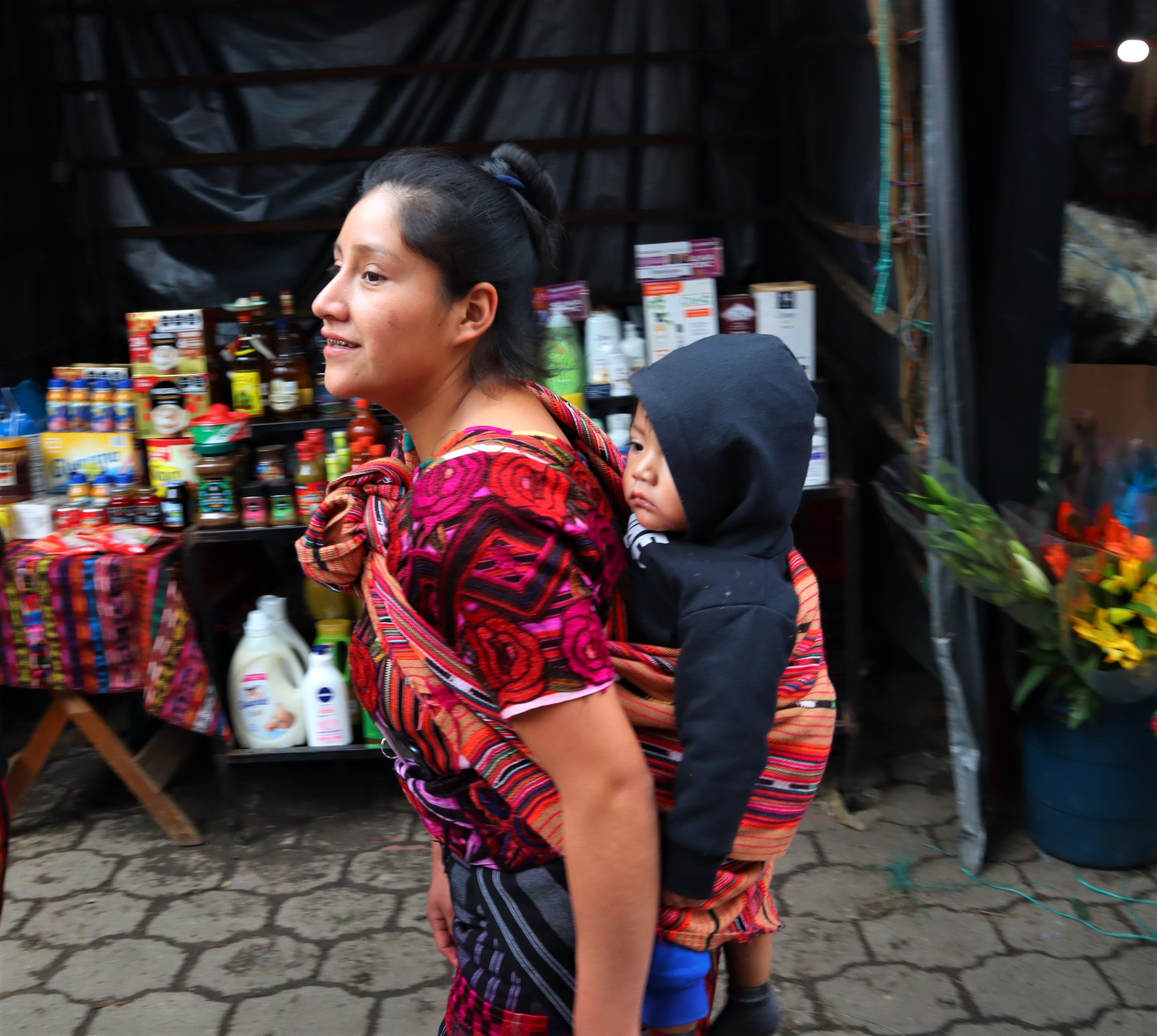
We reached the harbor at Santiago Atitlan after about 20 minutes of vertebral readjustment and climbed out of the rocking lancha onto the dock into a steady downpour.  Umbrellas up, we arranged a meeting time with the boat driver and began to make our way into the steep streets of the town. If you'd have plunked me down at this spot and forced me to guess where I was, I'd have more likely said Kathmandu than Guatemala given to the steepness of the streets, the quantity of tuk-tuks zipping people up them, and the near 100% concentration of women wearing indigenous dress. They wore intricately embroidered huipiles as blouses, topped by shawls and belted over long, woven wrap skirts, sometimes themselves covered by lacy-edged aprons. Many had panuelos (squares of woven fabric) folded to cover their heads and wrap up things to be carried on the head. The colors and textures of the traditional dress were overwhelming to absorb at once given their intricate patterns and vibrant colors. 


With roads turning to rivers and hardly any room on the shoulder to avoid being doused by the passing tuk-tuks, we ducked into a cafe for a coffee and for me, the first of many Guatemalan spicy hot chocolates. 


As the rain finally relented, we ventured up the now-drained cobbled streets to the top of town to find the central plaza and cathedral. The standard architecture of the houses and buildings struck me as starkly different from El Salvador, and more reminiscent of the extravagent Roma (gypsy) houses we'd seen in Romania. Built completely of cement blocks (normal across the region), these buildings rose a few stories higher than I'd have thought advisable given the tiny slice of terra firma that formed their foundations and their location directly on the seismically active Ring of Fire. Most buildings had multiple columned terraces and were topped with either a covered rooftop garden/laundry line, or unfinished with spikes of rebar protruding from the blocks, ready for an additional story to be added someday. Both of these qualities exuded positive expectations of the future. 

Multiple stories and growing in Santiago Atitlan.

Typical Roma house in Romania - not Guatemala. 

Always ready to finish that extra story, someday. 

No slice of land left undeveloped.

She had the sense to come in from the rain, unlike us. 

With the rain settling in again, we cut our visit to Santiago Atitlan short after seeing the cathedral and made our way back to the dock via tuk-tuk. Our lancha driver was waiting for us and after a successful ambush at the dock by some roving saleswomen, we headed towards our second town and lunch spot - San Juan de Laguna. 

We are now the proud owners of a new table runner.

Always a cathedral at the top. 

Just a short boat trip around the corner of the lake shore brought us to San Juan la Laguna, a smaller and less busy town than Santiago Atitlan.  It's what I now refer to as an Instagram town because it is taking advantage of the modern day siren's song: colorful, catchy attractions visitors can simply shoot and post on social media. I'm not denying any intrinsic value of the town by any means, simply that the social media attraction can become the primary attraction and the historic or cultural essence of a place becomes more of a Disneyland backdrop. 

San Juan's Instagram hook was its steep main street, cobbled and painted in murals and over hung with colorful umbrellas and crafts. The street was lined with textile and pottery shops giving a vibrant and artisan background. Swingsets set in shallow water on the lakeside offered couples the perfect wedding shot, and high lookout points over the lake completed the Instagram trifecta. As if on cue, we encountered a group of American tourists hamming it up for each others' cameras on the carefully set stage. They're clever and photogenic, there's no doubt. Clearly local businesses benefit from the increased visitor attention and tourists learn of new places via social media that they might not have considered otherwise. However, I question the sustainability of these methods and hope the local businesses are making hay while the sun shines. 


With intermittant rain, we worked our way up the main street and chose a small, family run tipicos restaurant for lunch. A new friend joined us for lunch and a lovely view over the lake and misty mountains, and we had a pleasant meal before heading back to the boat. 

After a thoroughly needed cleaning...

...he settled into a nap on the table next to ours. Guatemalgato. 

Santa Cruz La Laguna

The next day we opted for the public lancha, like a bus on the water, and took a quick and inexpensive ride along the coast to Santa Cruz La Laguna. The attraction here was to find a quieter spot than the previous day and see a less commercialized town. Also, this town was home to CECAP, a successful community co-op, training center and restaurant a friend suggested we visit. Without yesterday's downpours, we were already feeling positive for the day and happily paid a tiny fraction of the cost for the public lancha than for the guy we'd hired the day before. Fool us once...   

Like all towns in this geography, the dock is about the only flat spot and it's all uphill from there.  While hard on the knees, the topography offers great views from every switchback in the road, and gives the tuk-tuk drivers a reliable stream of customers. We were passengers on the way up, and later with bellies full of lunch from the co-op cafe, walked down.  

Gym class in session - basketball drills for girls and boys

This topography keeps many towns reachable only by boat.

Local residents


Chichicastenango and Quetzaltenango - "Xela"

I woke up early on our last day and seeing no rain, grabbed my camera and headed into the waking city. The relief of having all the shops closed and roads vendor-free was outweighed by the quantity of dogs and copious amounts of dog poo deposited overnight that kept my gaze down instead of up. I stuck to the main streets in the hopes of avoiding packs of dogs - a few I figured I could handle - that tend to scavenge in trash heaps on the edges of town. I found a park already brimming with wholesalers come down from larger cities to sell their touristy goods to individual traders. I sat as inconspicuously as an American in a pink fleece jacket, sensible walking shoes and a camera could, and observed.


I've been spotted.


After three days in Panajachel, the skies were clearing as we pulled away from the lakeshore and began to climb out of the caldera. The water's surface was smooth for the first time since we arrived and we caught glimpses of the volcanic backdrop that visitors take for granted in the dry season.  


En route to our second stop Quetzaltenango, nicknamed simply "Xela," we detoured to the town of Chichicastenango to see its enormous biweekly market. Touted to be one of the largest in Central America, I didn't doubt these claims for a second. Entering the market's labyrinth of lanes and aisles felt like drowning in color and texture and being so overwhelmed by the variety and volume that I simply couldn't absorb it all. We had decided what we were looking to buy before heading into the melee, battle armor on, as entering the fray undecided would tempt migraine-inducing levels of indecision. Fortunately we found a few quiet spots on the edges of the market that understood the intrinsic value of not harrassing the shoppers, allowing us to take in their gorgeous displays and ask questions without having to swat anyone away from our elbows. We picked out a small piece of fabric embroidered with birds that I'll hang on the wall, a blouse and a few little bits to share with family in the coming holidays (spoiler alert). 

There's always a critic...


Slapping out tortillas and chatting in K'iche'


Two churches towered over either end of the market, their steps occupied by the devout swinging censers of burning incense or men stoking aromatic fires of pine and copan. One church also served as stage for a gaggle of Instragram ladies. I took advantage of speaking English to eavesdrop.  

"I feel awkward."  

"No, you look cute - don't worry! Just turn sideways a little."

"Like this? It doesn't feel natural."

"Act like you're walking up the stairs and then turn like I called your name. Put your hand on your hip or something."

"That's not how I walk up stairs."

"But it looks cuter that way."

"Like this...?"


The drive to Xela took us through what is essentially Central America's produce section. Every square meter that could be farmed, was. From large-scale industrial operations to small holdings, the countryside unfolded below and rose above us in geometrically precise terraces. Unlike El Salvador where we only see corn, beans, sugarcane, and coffee bushes in the higher altitudes, the combination of Guatemala's cooler climate and rich volcanic soil make it incredibly fertile to cultivate an enormous variety of produce.

We learned from a waiter a few days later that the individual land owners will work and harvest their own crops, then take them to a center where they are weighed and put onto a buddy's truck to be transported and sold at a larger center for transportation further afield. The key was having access to the truck, and the mid-90s Toyota kitted out with high-sided carry racks was the clear favorite. 


Toyota is missing out on some serious product endorsement in Guatemala. 

We'd rented a cabin that was meant to be both in the heart of the city and also surrounded by idyllic, grazing-cow countryside. Both of these descriptions were accurate, but the advertisement oddly omitted the fact that the cabin was one among many clustered on a pretty hillside overlooking and overhearing the commercial car parts and semi-truck repair hub of Guatemala's second-largest city. Details, details. 

Our little pied a terre for three nights. 

Neighboring cabins. 

Just out of view to the right, and this fact will come into play later, was a larger, fancier and more modern house with a bit of a lord-of-the-manor weekend getaway feel to it amongst the small, rustic cabins. 

We were excited to head into the historic center of Xela on our first full day in the city and found it, as promised, just 15 minutes' drive away from our homestead. The central square, bordered by colonial churches and municipal buildings, gave us a good sample of the beautiful architechture we'd be swimming in on our last leg of the trip - Antigua. Xela's downtown center was markedly tidy, quiet, and dog/dog poo free in comparison with the tourist-centric smorgasbord we'd felt in Panajachel. It was a functioning city in its own right and not surviving only on the tourist teat, therefore we enjoyed a sense of relative anonymity and peace in exploring the shops and historic buildings. Just a city going about its business whether we were there or not. 


Cafe and terrace on the upper left. 


We poked around one of the buildings along the main square that had been refurbished to accommodate new businesses and climbed the stairs to the second floor to find a coffee shop with a terrace overlooking the park. My husband had a berry-covered cheesecake and I ordered a cardamom-spiced coffee. 

I took advantage of our anonymous perch to shoot pictures of people in the park, in particular a tiny girl who was manning a small stand on her own. Bored as we all were at the age, she was sprawled across the sidewalk and gutter, sucking on a candy from her stand. We'd noticed her when we were at ground-level and had remarked that she was awfully young to be by herself. As we enjoyed our treats and soaked in the sunbreaks from the terrace, I kept my eye on her. A half-hour after we first spotted her, she was still alone, and still at the hour mark. We witnessed her in action as two young men stopped to buy indvidual cigarettes; she told them the prices, took their money, made change, and gave them a light. My husband wondered how it felt to buy your smokes from a five-year-old. Later, another man came by and inquired about something on her tray. She pointed out various options, he made his choice and paid her with a larger bill. At this point, she raised her head to look down the road and snapped the bill in the air to get someone's attention. That's when her mother, or minder, or at least an adult, came by, made the change and without so much as a pat on her head, returned to her own cart. The girl took another sucker off the tray as commission and stuffed it into her mouth.


Passing by as we left the park, I stopped to chat with her. Her name was Cindy, and indeed, she was five. It was a weekday and at first I thought what a shame that she wasn't in school, but then it occurred to me that she was too young to be in school. She seemed to sell only cigarettes, masks, a few suckers, and a large bag of kids' balls. Essentially, things she was less likely to personally consume and lose profits from. She spoke Spanish clearly and confidently to me as I picked out a mask from her table. Later that night, my husband and I returned to the downtown for dinner. After our meal, on the way back to our parked car sometime after 9:00, we saw Cindy again. This time she was with a somewhat older girl, maybe 9-10 years old. They were laughing and running from the park up a side street. Still no parent in sight. Little Cindy Lou Who.

Our last night in Xela started out well, but while taking an afternoon stroll around the hillside, I noticed the fancier house about 150 yards from our cabin was setting up for some type of event. Rented tables and chairs were spread across the yard, one of them lined with shopping bags stuffed with large bottles of liquor and mixers. A DJ was setting up his booth. This was not good. At 6:00 pm the music started and guests began to arrive. My husband spotted one carrying a balloon with the number 8 on it. He must've missed the other balloon with the 1, as we quickly figured this was an 18th birthday party, i.e. your first legal drinking party. The school bus came a bit later and parked in front of our cabin, as did all the other party-goers' cars. We did not embody the spirit of, "If you can't beat 'em, join 'em!" that our Air BnB host suggested when I let him know what was going on. The music was hideous in addition to being absurdly loud, and it lasted until just before 2:00 am when the DJ packed it in and the school bus fired up and drove away. We managed to catch a few hours' sleep (few = two) and woke to find, unsurprisingly, red plastic cups strewn across the yard and a few remaining cars of those sensible enough not to drive.

But the real surprise came after we'd grumpily stumbled around the cabin packing up and squabbling with each other, shoved our things into the back of our car, and swore (to ourselves) at the entitled ignorance of our rich-kid neighbors. My husband turned over the ignition and the car made a decidedly louder noise than it ever had before, as if its ears were still ringing from the party and it felt the need to shout at us. On his back in the grass, my husband found a crack in the exhaust pipe, just where it joined with what I now refer to as the "deputy muffler."  (And please note my expertise on such matters.) We chuckled, sarcastically noting that well at least now it was good to be in the car parts heart of the city. Optimistically we headed down the road. A moment later, driving by row after row of completely closed businesses, we then remembered it was Sunday. Ain't nobody working today. 

Cruising slowly through the closed-down, oil stained and rough-around-the-edges neighborhood made us feel like we were trying to score something from someone, and I suppose we were, so we were reluctant to engage the young man who approached the car asking what we needed. Car parts store?  He shook his head. It's Sunday. Ain't nobody working today. But then he paused and pointed across a busy road to a narrow doorway, "Except him. He's open today."  

After a quick translation of car parts terminology on the phone, my husband jogged across the multi-lane avenue to the one open business and I stayed in the car to keep an eye on our things. Moments later I watched him from the distance engaging in some type of negotiation with two men. With a spring in his step, he shortly returned with a roll of duct tape - because you never know - and word that he met a guy who knew a guy nearby who knew how to weld and if we could go to his house - he'd see what he could do for our car.  Score! We followed helpful guy one to guy two's garage in a dirt-road neighborhood of humble houses. 

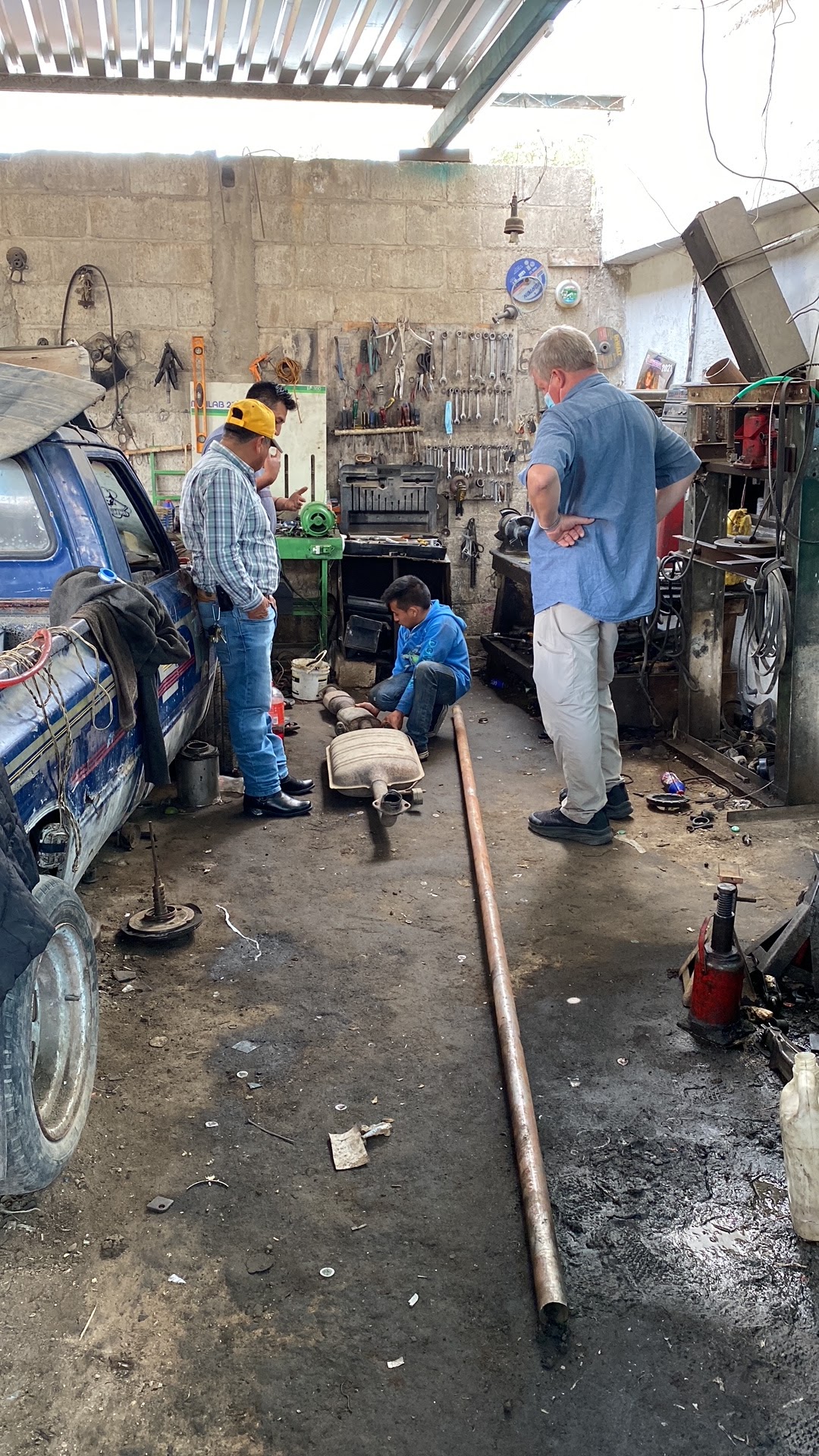
First the man's two teen sons came down the lane, opening the garage and directing us to pull in. Without a further word, they jacked up the car and one slid underneath on a piece of cardboard. They spotted the crack and before their father could arrive to consult, had the catalytic converter and exhaust system dismantled and pulled into their work area. With much discussion amongst themselves and including my husband, followed by rifling through piles of pipes, gaskets and whatchamajiggers, they welded a makeshift repair to the car. They then firmly recommended we get it checked at our next stop. $28 plus a $6 tip later, we shook hands, thanked them for their work on a Sunday, and hit the road for the three hour drive to Antigua. The kindness of strangers who know how to weld should never be underestimated.


Antigua - We made it!

The weld job held, more or less, and we pulled into Antigua's cobbled streets by about 3:00 pm. The former Guatemalan capital and prized jewel of colonial architecture, Antigua certainly needs no introduction. However, we still hadn't met her, and so after settling into our lodging (a funky "condo" decked out in 1980s furnishings within an 19th century building), we took a wander through the neighborhood. Each turn brought us face to face with yet another stunning church from hundreds of years ago, either completely remodelded or in progress. No expense spared, no attention to detail overlooked. This town knows what it has in its tresure chest and is protecting and polishing it.  


Following the advice of the welder family in Xela, we began to ask around for a reliable mechanic who could give the underbelly of the car a look. This conversation started as it often does - with our waiter. We found a live wire on our first try and while emptying our bowls of delicious Guatemalan stews, he expounded on the potential perils of walking into an unknown garage and expecting quality, honest service. Nope, he could not recommend that. However, he had just the guy for us where he was certain we could get a fair appraisal; just give him a call in the morning and he'd set it up. After another ten minutes' explanation of, "And if he doesn't have the right part - he'll dispatch someone to Guatemala City to get it. No problem at all. It's how we do things here. You'll be in good hands!" Given his earnest enthusiasm - and no other options - we settled on that plan and ended the evening by polishing off a plate of plantains drowned in dark, semi-sweetened chocolate sauce. 

The next morning we contacted the waiter as promised who reluctantly admitted, "I called my friend. He doesn't do exhaust systems. No one here does. You have to go to the capital. Sorry. Good luck!"

At least it was a lovely dinner. 

My husband skinnied under the car a few more times, comparing what he saw with what Dr. Google taught him and concluded that we'd be fine making it home without further repair. With our schedule now free from spending a day hunting down and then sitting in an auto shop - we began to explore Antigua in earnest. For me, this always starts by seeing the city wake up.

Antigua wakes up far differently from Xela or Panajachel, and differently from the towns we've visited in El Salvador, too. Instead of seeing people leaning against their doorjams to let the dog out or flag down the bread boy, parents walking kids to school, workers streaming to the edge of town to catch buses, or hot food stands setting up on the sidewalk - Antigua receives the outside world each day via buses. Essentially, regular folk can't afford to live inside the precious historic center, its real estate more valuable for shops, restaurants or hotels to be kept for working-class people. The city's lifeblood arrives in buses, disgorging dozens at each stop. These are folks who got on the bus who-knows-how-long-ago in their home towns, pulled their sweatshirt hoods up high, let their heads rest against the window, and caught that extra bit of sleep before facing the work day. Some hopped off the buses in neatly pressed hotel uniforms, others in workboots and jeans, but all were taking advantage of what I imagined were good, reliable jobs in making the clean, safe, well-serviced, and beautifully restored city we marveled at. 

Bus from the capital arriving. 


My conversational Spanish was highly amusing to these regular bus stop dudes.

His charm necklace caught my eye.  He called them "diamantes" and upon closer inspection, they told an interesting story about their owner. 

While the sidewalks are still passable.

By late morning, the sidewalks and shops were already brimming with tourists, international visitors to be precise, and we were there on a weekday in the rainy season. So international is the crowd that when waiters or shop assistants approached us, they asked if we spoke English or Spanish? (Really? Do WE speak English?) We're not used to being confused for, I dunno, Hungarians? Slovaks? Greeks? We're certainly not stylish enough to pass for French or Italian. Asking if we spoke Spanish was due in no part to our flawless accents as we said "buenos dias" and asked for a table, but to Antigua's high number of language schools attracting students from around the world. They're right; we could have been two adventerous Croats here to learn Spanish, point given. 

By afternoon, the storms blew in and turned the streets into, and I'm restraining myself from exagerating here, raging, uncrossable torrents. Yes, I believe that is an accurate description. The first time it happened, in a scramble to find cover we were shoo'ed away from a fancy establishment by the parking guard and had to dive into a friendly little grocery/bar to wait out the worst of it. 

Breeze in the tablecloth warning of the coming downpour.

These storms are intense but short lived and the tides eventually receded. The rest of our afternoon wandering was in squishy socks and shoes that eventually warmed into little wetsuits on our feet. 

Obligatory Arco de Santa Catalina shot with ambulatory vendors.  

An emporium of Guatemala's Greatest Artisan Hits. 

On our final full day, we found Jade Maya. An hour flew by drifting among the showcases of jade jewelry and carvings ranging the color spectrum from creamy white and pale purple, to the classic translucent green, to nearly black, to then watching the cutters and polishers at work, and finally learning the stone's history in Mesoamerica at their museum. We chatted with the salesman Rafael first about jade, naturally, and then about his photography. Before leaving we exchanged contacts as he invited us to come see and shoot some of the religious festivals Guatemala is know for.  These two photographs are Rafael's:


We found lunch between cloud breaks at an outdoor cafe aptly named El Garden where we met Adriana, the owner and butterfly enthusiast. She had seen me leap to my feet during lunch to catch photos of this little friend fluttering by, and as we were leaving, she pulled us aside to see her protected butterfly garden. Here she carefully cultivates, if that's the right word, zebra butterflies by giving them the plants they want to eat and on which to lay their eggs, protection for the caterpillers, places for the chyrisalides to hang, and finally she releases the adults to places where they can thrive and go about their polinating lives. 


All road trips come to an end, and our last supper was at another tipicos restaurant where we had the red sauce beef stew pepian and the green salsa pollo en jocon and wondered why Guatemalan food was so much more flavorful than Salvadoran. (Sorry!) There were very few other occupied tables given the wet weather and so we took advantage of a conversation with the waiter, aka one of my favorite things to do. After hearing we were Americans, he said he had considered making the trek north across the border to find work, but decided last minute not to risk the dangers of the road. Speaking as if having heard it from friends, he commented that the land of opportunity might not be as shiny in reality as in the dream. "Ten days of work to pay for one day of living" and concluded it just wasn't worth it. He had a good job, lived in his home town with friends and family and what more did he want? 

The next morning as we headed east, winding out of the mountains and back towards the coastal plain and border, I reflected on how much we'd learned and seen. With just one border crossing, we'd experienced a markedly different culture, cusine and reception as tourists from what we knew so well in El Salvador. None of the above were necessarily negative, in fact most were very positive, but just so very different. It felt good to be home where we were comfortable. El Salvador has its own challenges and difficulties, for sure, but they are ours and we know them. 

Pulling into the garage after the six-hour drive, my husband said, "It was an interesting vacation. I can't say it was fun, but it certainly was interesting."  Indeed.